

-

Applications

Industries

 OEM & ODM Service
 Development Service
 Download
 Technical support
 Warranty & RMA
 FAQS
FAQS
 My Community
 Who Is CIVINTEC
 Why CIVINTEC
 News & Express
 Cooperation





 Jun 12, 2026
The operational model of the modern manufacturing plant is moving rapidly away from mechanical structures toward data-driven industrial environments. As factory floor operations integrate automated assembly lines, real-time supply chain updates, and interconnected Industrial Internet of Things (IIoT) sensors, a parallel shift must occur within physical security networks. Industrial compounds are no longer just physical facilities; they are complex infrastructure centers where physical spaces and digital intellectual assets are deeply connected.
For security managers, plant directors, and IT executives, managing access rights for a rotating distributed workforce represents an ongoing operational challenge. Thousands of full-time employees, specialized shift workers, seasonal inventory contractors, and heavy-freight delivery drivers move through main entry points, manufacturing cleanrooms, and loading docks daily.
Relying on traditional authentication methods—such as mechanical keys, unencrypted low-frequency badges, or standalone local keypads—creates operational friction and introduces significant security blind spots. To maintain complete visibility and long-term agility, modern industrial firms are updating their security architecture by implementing a mobile-first, software-defined enterprise access control system.
While high-frequency RFID cards offer an improvement over legacy mechanical locks, a purely physical card infrastructure introduces ongoing logistical challenges and hidden operational expenses for large-scale production facilities.
Industrial production hubs often operate with high personnel turn rates, especially when hiring seasonal logistical staff or bringing in temporary specialized assembly line technicians. Managing a physical badge program for this fluctuating workforce requires significant administrative effort.
Every new hire requires a security officer to physically print, configure, and issue a dedicated proximity card or smart badge. When employees lose, misplace, or forget their credentials, administrative staff must pause core tasks to verify identities and issue replacements.
Over an enterprise access control system managing multiple sites with thousands of employees, the cumulative cost of blank plastic stock, specialized dye-sublimation printer ribbons, and lost administrative hours can become a significant annual operational expense.
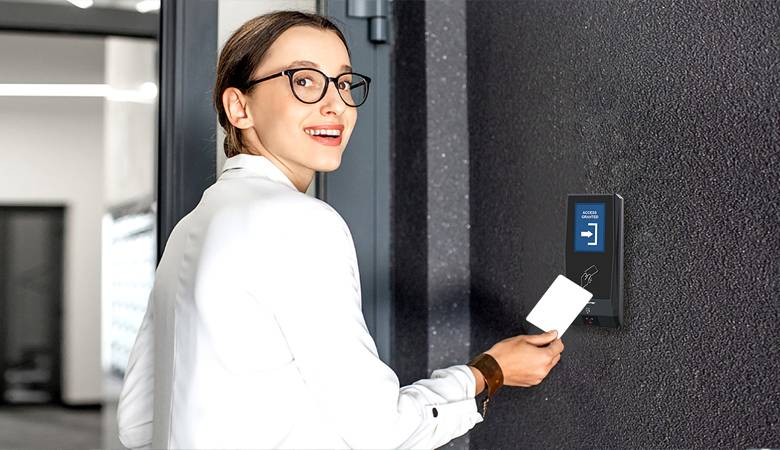
In large manufacturing complexes, hundreds of workers often arrive and depart simultaneously during shift handovers. If the enterprise door access control systems installed at main security gates or turnstile banks take even two to three seconds to read, validate, and process a physical card credential, large queues form quickly. These entry bottlenecks delay floor handovers, disrupt production timing, and impact workforce morale.
Where T represents the throughput capacity, P represents the active personnel pool arriving simultaneously, LR represents the hardware reading and processing latency, and LH represents the human behavioral delay (such as hunting for badges or positioning cards). By eliminating physical cards, an enterprise can minimize LH and optimize LR, significantly increasing throughput during peak shift handovers.
Furthermore, in industrial environments where employees are required to wear heavy protective equipment, search and rescue suits, or high-cleanroom garments, searching through pockets to find a small plastic card introduces unnecessary operational friction.
Physical cards represent a security variable because they cannot verify if the person holding the card is its actual owner. "Buddy punching"—the practice of an employee scanning a coworker's badge to log them into a shift early—remains an ongoing challenge in industrial environments.
More importantly, if an employee loses a badge outside the facility and does not report it immediately, that live credential can be used by unauthorized individuals to enter the site. This vulnerability exposes high-value tools, hazardous chemical stores, and sensitive network rooms to physical intrusion, equipment tampering, or IP theft.
[block1]
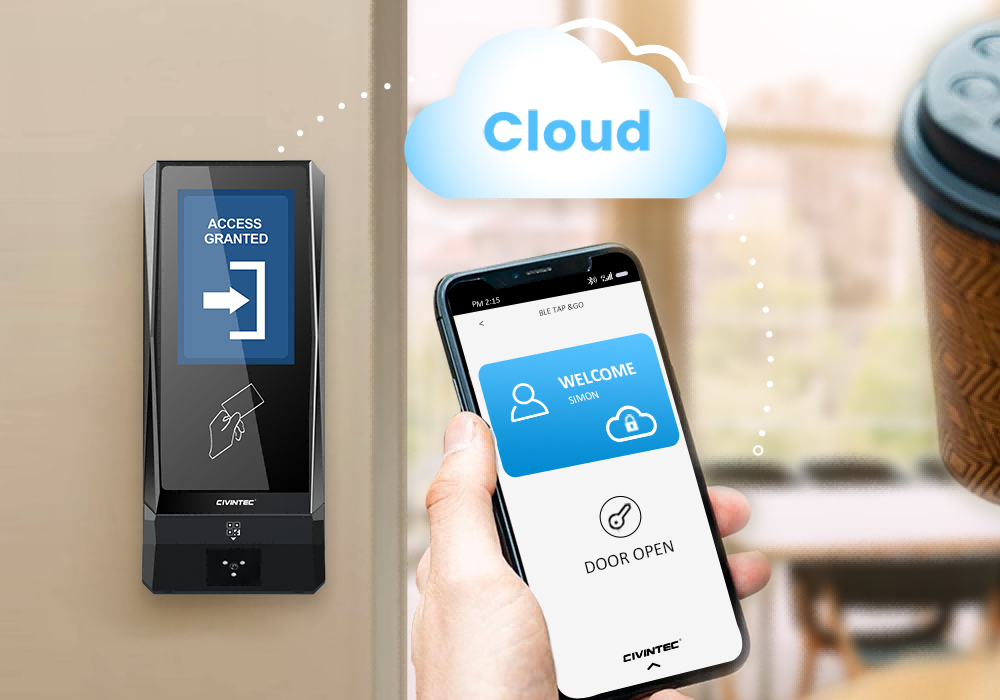
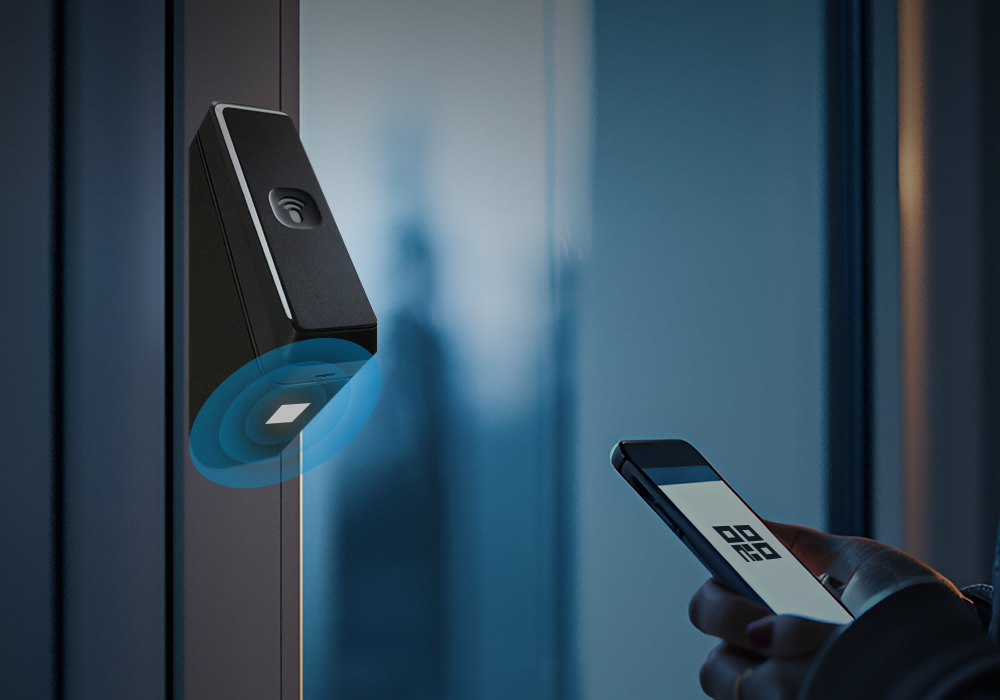
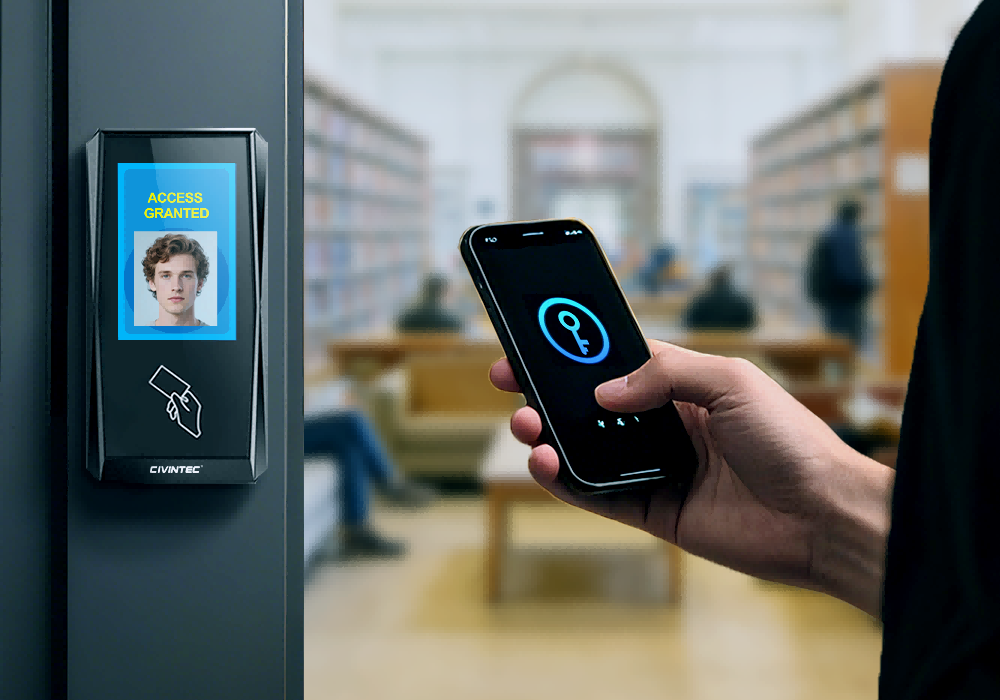
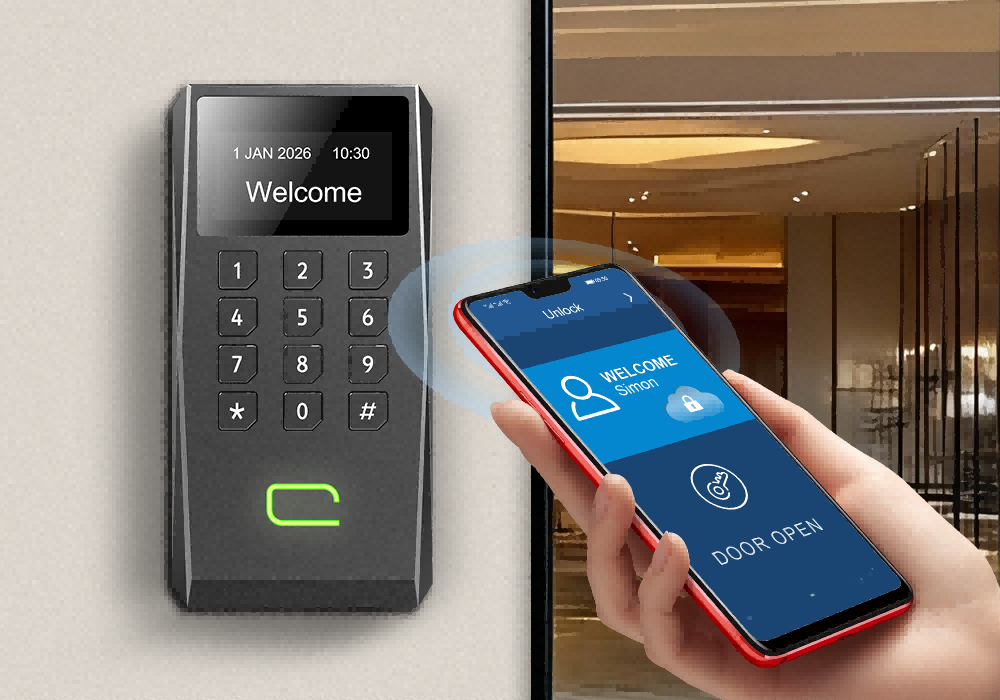
Transitioning to a mobile-first authentication strategy allows industrial facilities to address the logistical challenges of physical badges by turning the smartphone into a secure digital credential. Modern enterprise access control solutions utilize the built-in BLE/NFC wireless capabilities of consumer smartphones to establish an entry process that is both highly secure and user-friendly.
Mobile credentialing relies primarily on two short-range wireless communication protocols, each serving distinct operational functions within a factory environment:
NFC Access Control Subsystems: Near Field Communication (NFC) mimics the intuitive, short-range interaction of a traditional contactless card. Operating at a frequency of 13.56MHz and restricted to an active reading distance of less than 4cm, NFC requires a deliberate movement from the user. The employee must bring their smartphone close to the enterprise access control reader face. This precision makes NFC an ideal choice for high-security areas, inner laboratory doors, and sensitive material vaults where accidental openings must be strictly prevented.
BLE Access Control Subsystems: BLE operates across the 2.4GHz spectrum and enables long-range sensing configurations. A ble access control reader can detect and authenticate a mobile credential from distances ranging from a few centimeters up to several meters. This enables a "hands-free" entry process. As an authorized worker walks toward a door, a turnstile, or an automated vehicle gate, the reader detects their smartphone's encrypted BLE token in the background, validates their permissions, and opens the barrier automatically. This capability is useful for warehouse personnel operating forklifts, logistics teams moving freight, and plant engineers carrying tools who cannot stop to manually tap a card or device.
Moving credentials to wireless frequencies requires strong cybersecurity protections. CIVINTEC mobile systems secure these transmissions by using bank-grade Advanced Encryption Standard (AES-128/256) cryptographic algorithms to protect the communication over the airwaves.
When a mobile app connects with a CIVINTEC access control reader via NFC or BLE, the devices perform a multi-step cryptographic handshake. The credential data is never transmitted as open, unencrypted text. Instead, it is wrapped in an ephemeral, single-use token that changes after every transaction. This protocol protects the data link against "Sniffing Attacks"—where a malicious actor attempts to intercept wireless signals with an antenna—and completely prevents "Replay Attacks," where an attacker records an authentication signal to broadcast it later and unlock a door illegally.
By deploying mobile credentials, an organization benefits from the built-in hardware security features of modern consumer smartphones. Unlike passive plastic smart cards, mobile credentials can be stored inside the phone's hardware-isolated Secure Element (SE) or Secure Enclave.
Furthermore, the system can require users to complete biometric checks—such as Apple FaceID, Android BiometricPrompt fingerprint scans, or a secure lock screen PIN—before the mobile app activates and transmits its access token. This multi-factor approach ensures that even if an employee loses their phone, the digital key remains locked and inaccessible to unauthorized users.

Upgrading to a mobile-enabled enterprise access control system allows industrial operations to connect physical security management with backend workforce optimization platforms, improving overall operational efficiency.
In many legacy factories, physical building access and employee time tracking run on separate, disconnected platforms. Security guards manage entry gates while workers log into shifts using a standalone mechanical punch clock or an independent barcode reader. This separation requires administrative teams to manually cross-reference paper sheets and export disparate data tables to calculate payroll, a process prone to human error and data entry discrepancies.
By implementing a unified access control platform for enterprise facilities, the acts of entering the facility and logging a shift are combined into a single event. When a shift worker passes through a main entry gate using their smartphone, the edge terminal validates their security profile and instantly logs a timestamped arrival event to the central management database. This automation gives operations managers a real-time view of current staffing levels across the factory floor and provides payroll departments with clean, accurate, and pre-audited time tracking data, eliminating manual errors and reducing time fraud.
Every minute an assembly line stands idle during a shift change impacts a factory's daily output. Mobile access control speeds up these handovers by creating an automated entry pipeline. By utilizing long-range BLE readers at main factory gates, employees can pass through turnstiles at normal walking speed without stopping to search for a badge, significantly increasing throughput.
This automated synchronization helps facilities optimize floor access and improve personnel management. For a practical example of this operational model in action, see the CIVINTEC case study on deploying a keyless door access system and time attendance framework, which outlines how large production facilities combine secure entry points with automated shift tracking.
Moving to a mobile-first architecture does not require an organization to change its entire credential infrastructure overnight. Large operations require an adaptable transition phase where legacy cards, high-security smart badges, and mobile devices can be processed simultaneously across the same facility. CIVINTEC meets this need by developing edge-processing terminals that support a wide range of credential formats, helping organizations deploy tailored enterprise-level user and access control solutions across all facilities.
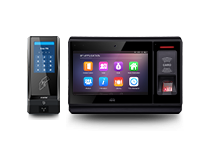
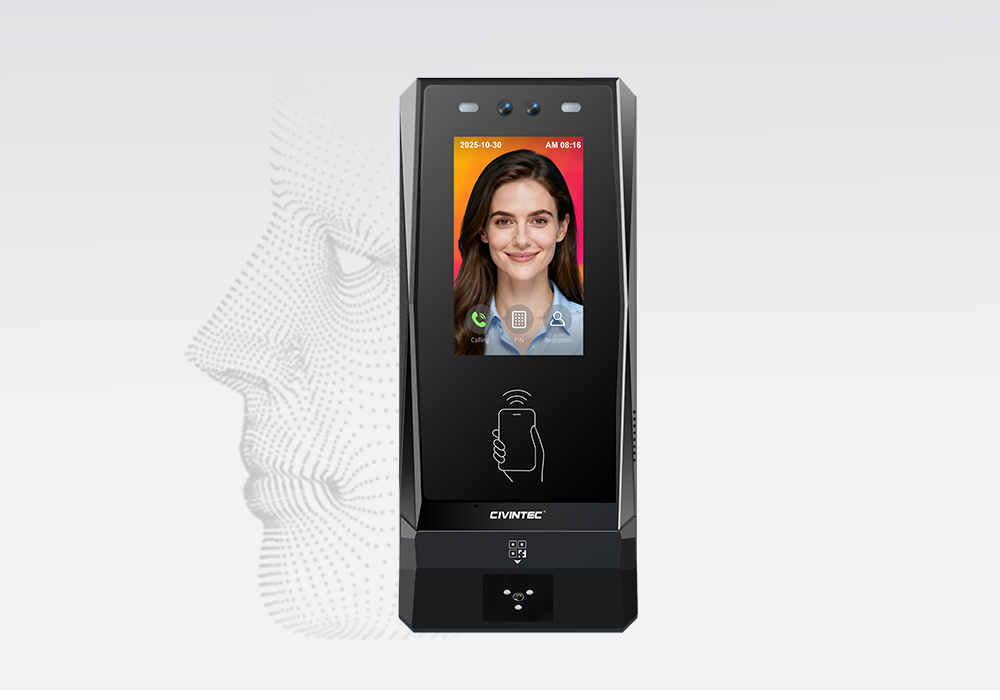
The CIVINTEC CT10 access control terminal is an advanced touchscreen access control device engineered for primary perimeters, high-traffic employee entrance turnstiles, and main corporate reception desks.
Multi-Format Processing Core: The CT10 features dual-frequency reading modules capable of decoding legacy proximity tokens, advanced access control smart card reader profiles, and modern mobile app credentials on a single platform. This lets procurement managers distribute cost-effective mobile keys to the general workforce while retaining physical badges for specific operational roles.
Cloud Centralized Management: Support wire/wireless connectivity Ethernet(PoE), Wi-Fi, LoRaWAN, 4G LTE and enables cloud-based remote management, allowing door access control and real-time entry monitoring from anywhere to ensure efficient, centralized supervision across zones.
Industrial Durability for Main Entry Points: Built with IP65 waterproof and tough, UV-resistance materials, the CT10 is designed to handle continuous use in busy environments while maintaining a clean, professional appearance.
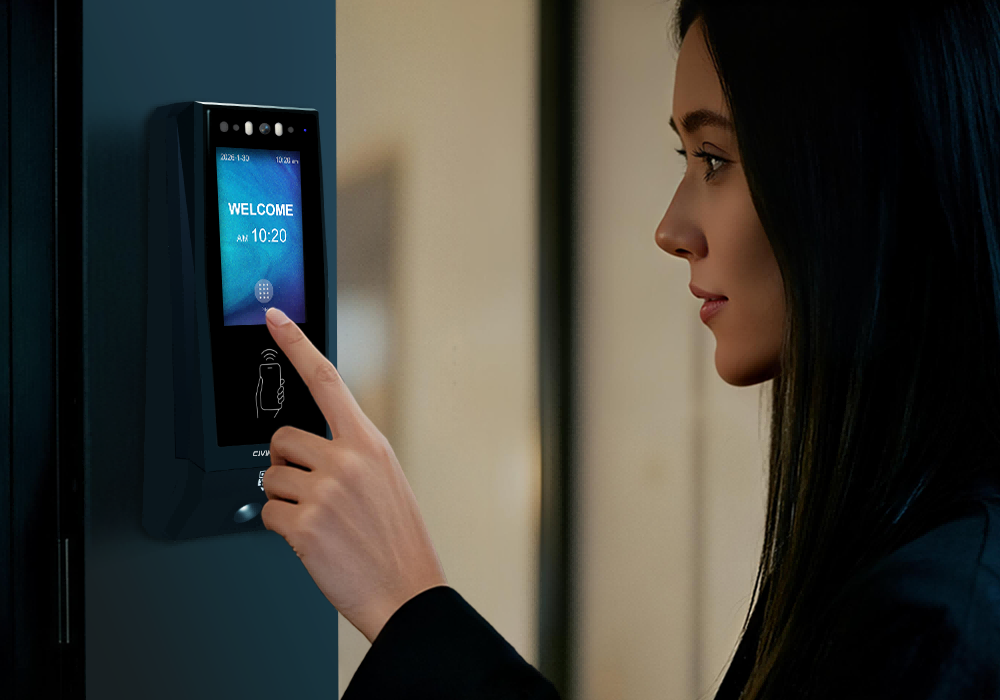
The CIVINTEC CT9 Pro access control terminal is a heavy-duty, all-weather terminal designed to operate reliably in challenging industrial environments and on exterior building walls.
IP65 Ingress Protection Rating: The CT9 Pro is fully sealed against fine airborne conductive dust, splashing water, and industrial chemical vapors, allowing it to function consistently in heavy fabrication areas, outdoor loading docks, and chemical storage yards.
Seamless Mobile Integration: The access control terminal features integrated long-range BLE and short-range NFC modules. This combination allows for precise "tap-to-go" access at secure internal doors alongside hands-free entry at logistics bays, where warehouse personnel carrying goods or operating vehicles can unlock doors automatically as they approach.
Customization and Flexible Interface Deployment: The CT9 Pro's adaptive interface allows system integrators to load custom branding, specific security warnings, and localized information directly onto the device, making it highly adaptable for global multi-site installations.
Flexible Software Integration: Supported by a flexible HTTP/HTTPS API structure, the CT9 Pro allows developers to connect its scanning engine directly with localized enterprise management platforms, facilitating fast data exchanges and real-time perimeter monitoring.
As industrial threats become more sophisticated, organizations must bridge the gap between physical facility security and digital network architecture. Modern security models treat a physical entry point and an IT network login as part of the same unified security boundary, integrating access control enterprise and corporate systems under a shared framework.
In automated factories, a physical security breach can lead directly to a digital disruption. If an unauthorized individual gains physical entry to an operator booth, they can access control terminals running the facility's SCADA or Manufacturing Execution Systems (MES).
Integrating your enterprise physical access control system with your broader IT monitoring infrastructure ensures that local control terminals remain locked unless an authorized operator has been validated at the room's physical entry point. This integration forms a strong multi-layered defense that protects critical infrastructure from unauthorized local access, supporting logical access control systems for enterprises and safeguarding sensitive enterprise data access control resources.
Modern multinational organizations often centralize their security management using cloud-hosted identity infrastructure. Managing data access control for enterprise applications in cloud computing environments requires that physical event logs are treated with the same rigor as network login attempts, turning your physical readers into active endpoints for data access control for enterprise applications.
By routing edge event notifications from CIVINTEC terminals directly to a central cloud SIEM (Security Information and Event Management) platform, security teams can monitor the entire organization from a single dashboard. If a user's digital identity logs into a corporate cloud application from one location while their mobile credential simultaneously attempts to open a physical door at a distant regional plant, the system flags the contradiction immediately, helping administrators intercept potential credential theft in real time.
In a cloud-centric world, the performance of a security system is measured by the milliseconds between a user’s request and the door’s response. At CIVINTEC, security and speed are not competing interests; they are the dual pillars upon which our hardware architecture is built. We provide a secure, high-speed tunnel that allows your cloud commands to reach the edge with zero compromise in integrity, ensuring the physical entry point feels like a natural extension of your software.
Data is the new currency, and protecting it is our highest priority. All data transmission between the CIVINTEC access control terminal and your management platform is protected by bank-grade HTTPS TLS 1.3 encrypted communication, ensuring that full-site data is SSL/TLS encrypted to prevent interception, tampering, or forgery. This end-to-end ciphertext transmission protects authentication, event logs, and cloud sync data from man-in-the-middle (MITM) attacks and traffic hijacking, even if the network is monitored.
Traditional access control often relies on local, static databases that can quickly become outdated. CIVINTEC terminals facilitate a sophisticated Real-Time "Cloud Handshake." When a user presents a credential—be it a card, a mobile credential, or a QR code — CIVINTEC access control terminal doesn't just look for a local match; it initiates an instantaneous verification request to your cloud software. Your platform validates the data against its master database and issues a real-time unlock command. This centralized logic enables real-time control over temporary visitor access and allows for instantaneous global policy updates, meaning a permission change made in your dashboard is reflected at the physical door in milliseconds.
Upgrading a large manufacturing facility from legacy proximity cards to a secure, mobile-first architecture requires a phased implementation plan that avoids disrupting daily production schedules or impacting access control related enterprises within your supply chain.
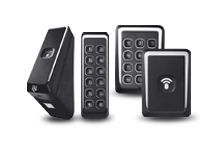
The first step is replacing obsolete, single-format proximity readers with flexible access control terminals like the CIVINTEC CT10 or CT9 Pro or access control readers like the CIVINTEC Cidron or CT5/CK5. These multi-technology units can be installed along existing wiring routes, allowing you to maintain support for legacy 125kHz cards while immediately enabling secure 13.56MHz MIFARE DESFire encryption and wireless mobile protocols. To choose the best configuration for your facility's layout, make sure your access control terminals match the physical space constraints and environmental demands of each specific location.
To help select appropriate structural configurations, engineers can consult the guidelines on how to choose CIVINTEC & Cidron access control readers for smart buildings to evaluate physical architectural demands.
Once the hardware upgrade is complete, administrators can begin issuing mobile credentials through the organization's central directory via enterprise access control software. New hires, transport drivers, and corporate staff can be onboarded digitally via an automated activation email, bypassing the front desk entirely. This hybrid phase allows management to evaluate system performance and verify data synchronization with time tracking software before moving to a wider rollout.
After verifying system stability, the general workforce can be fully transitioned to smartphone-based credentials using a robust enterprise access control solution. Physical card printing can be scaled down, reserving badges primarily for specialized cleanroom environments where mobile devices are restricted. At this stage, multi-factor verification—such as requiring a mobile scan plus an enterprise biometrics access control check or a randomized PIN entry—should be enforced at all critical equipment cages and server infrastructure points, creating a secure, future-proof industrial facility.
For projects requiring enhanced security layers, integrating specific verification models from the CIVINTEC guide on multiple identification technologies for high-security access provides an optimized path toward secure physical data segregation.
The table below evaluates different credential formats based on their security features and suitability for challenging manufacturing environments:
Evaluation Criteria | Legacy 125kHz Proximity Cards | Encrypted 13.56MHz Smart Cards | Smartphone Credentials (NFC & BLE) |
Cryptographic Protection | None. Transmits card numbers in unencrypted open text. | High. Built-in 128-bit AES encryption engines. | High. AES encryption with rotating single-use tokens. |
Cloning & Forgery Resistance | Low. Can be easily duplicated using cheap online tools. | High. Protected by mutual authentication checks. | Very High. Stored in the phone's secure hardware enclave. |
Administrative Overhead | High. Requires physical inventory, printing, and hand distribution. | High. Requires manual programming and physical tracking. | Very Low. Distributed instantly via automated cloud tools. |
Frictionless Entry Performance | Moderate. Requires the user to tap the card manually. | Moderate. Requires physical placement near the reader. | High. Enables hands-free entry from several meters away via BLE. |
MFA Capabilities | Low. Relies entirely on the user carrying the physical card. | Moderate. Can be combined with a fixed keypad PIN code. | High. Supports built-in smartphone facial recognition or fingerprint checks. |
Industrial Durability | Moderate. Cards can snap, scratch, or degrade over time. | Moderate. Plastic cards remain vulnerable to physical damage. | High. Protected within the user's personal smartphone. |
[block2]
Upgrading a manufacturing facility to a mobile-first access architecture is a strategic decision that improves long-term security, operational agility, and compliance across your business. Moving away from legacy card-based systems removes the administrative burden of badge printing, speeds up workforce transit during shift changes, and eliminates security vulnerabilities associated with lost or stolen credentials.
Partnering with an experienced access control manufacturer like CIVINTEC provides your facility with a highly secure, reliable hardware foundation. CIVINTEC access control terminals manage legacy proximity cards, encrypted smart badges, and modern mobile app tokens on a unified platform. This multi-modal capability helps you implement a zero-trust architecture that balances robust perimeter protection with smooth, hands-free convenience for your entire workforce.
Are you ready to remove operational bottlenecks, eliminate card printing overhead, and secure your production environment with advanced mobile credentials? Contact our senior engineering team today at the CIVINTEC Contact Page to request a customized hardware blueprint tailored for your facility's needs.


 Home >
  Share
Share




 Contact Us