

-

Applications

Industries

 OEM & ODM Service
 Development Service
 Download
 Technical support
 Warranty & RMA
 FAQS
FAQS
 My Community
 Who Is CIVINTEC
 Why CIVINTEC
 News & Express
 Cooperation




 May 27, 2026
The architecture of modern commercial properties is undergoing a massive digital transformation. Static facilities are evolving into interconnected smart environments where security, operational efficiency, and user convenience must coexist seamlessly. At the center of this transformation is the physical perimeter defense network, which relies entirely on the performance, compatibility, and structural integrity of edge devices: the access control readers.
Selecting the correct access control reader is no longer just a procurement box to check; it is a critical decision that impacts system architecture, cybersecurity posture, and long-term operating costs. For factory operators, system integrators, and B2B buyers, choosing the right hardware requires a deep understanding of multi-modal authentication technologies, industrial communication protocols, and mechanical form factors.
This comprehensive engineering and procurement guide outlines how to evaluate and select the ideal access control card reader infrastructure for smart buildings, utilizing the advanced, customizable product lines developed by CIVINTEC.
In any modern deployment, the door access control reader serves as the initial touchpoint between a human user and the building’s digital management platform. It acts as an intelligent edge processor that captures credential data, secures it via cryptographic algorithms, and transmits it upstream to a physical controller or cloud-hosted directory.
If this access control device lacks advanced security layers, the entire multi-million dollar security platform becomes vulnerable to physical interception, access credential cloning, and network exploitation. Furthermore, as access control facilities transition to hybrid workspaces, a single-format card reader door access control unit creates operational bottlenecks. Modern buildings demand multiple identification technologies capable of processing legacy credentials alongside mobile tokens and temporary visitor passes.
When evaluating access control system, understanding the fundamental key factors for choosing a reliable access control reader establishes the baseline for a secure installation. Systems must be analyzed through three operational lenses: credential versatility, communication security, and structural adaptability.
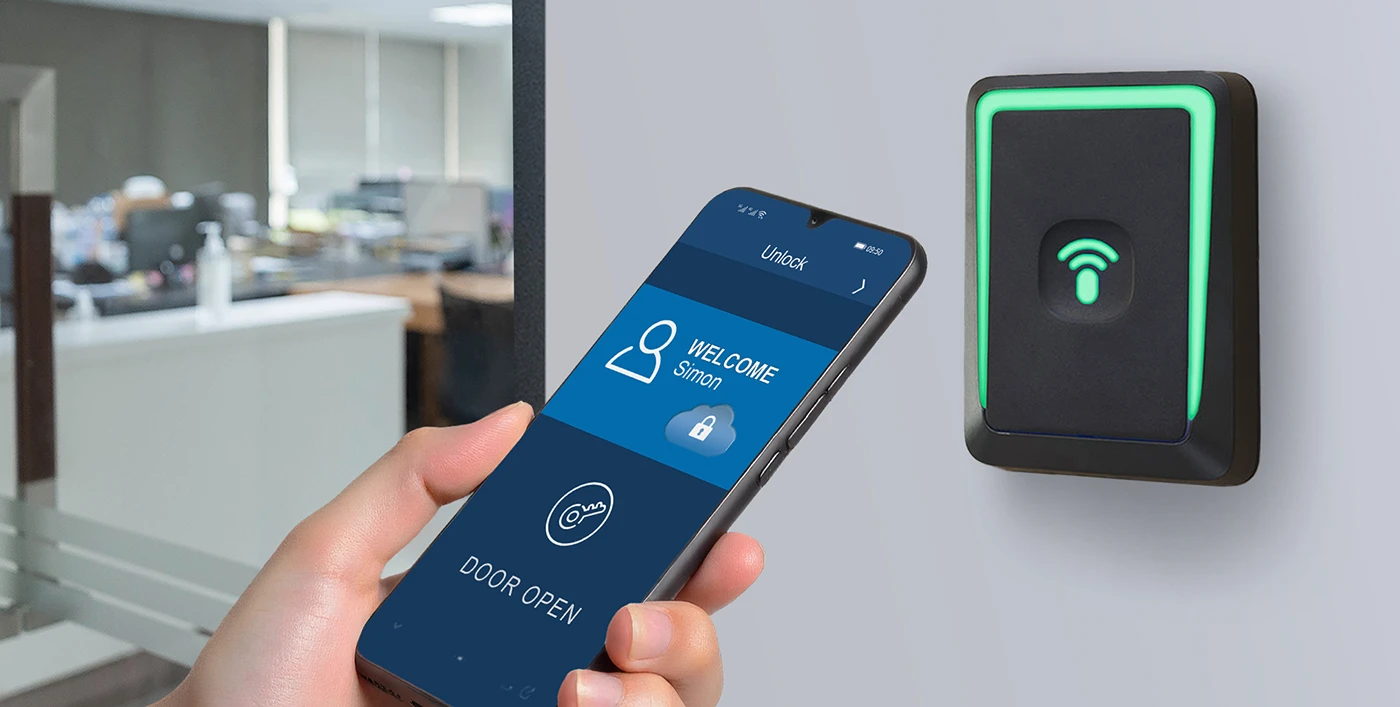
A common mistake in B2B procurement is treating all readers as uniform commodity hardware. In reality, the marketplace is divided into several access control card reader types, differentiated by their operating frequencies, processing speeds, and support for wireless mobile protocols. To future-proof a smart facility, hardware must support a multi-layered authentication matrix.
For decades, facilities relied on RFID 125kHz low-frequency proximity reader access control units. These legacy systems transmit card serial numbers (CSNs) in unencrypted, open text. Using simple, low-cost tools available online, bad actors can easily intercept, read, and duplicate these proximity cards.
To mitigate this corporate liability, smart building deployments must shift to high-frequency 13.56MHz access control smart card reader technology. CIVINTEC access control solutions focus heavily on the MIFARE® DESFire® EV2/EV3 platform:
Advanced Encryption Standard (AES): Utilizing 128-bit AES cryptographic engines, the access control RFID card reader secures data both on the card chip and during wireless transmission to the reader terminal.
Mutual Authentication Handshakes: Before any credential data is released, the reader and the smart card perform a mutual cryptographic verification. This step ensures that the reader possesses the authorized secret keys, preventing unauthorized skimming or "Man-in-the-Middle" (MITM) attacks.
SAM AV2/AV3: CIVINTEC and Cidron access control reader with embedded Secure Access Module support SAM AV2/AV3 and gives protection to further increase the security of storing encryption keys (Evaluation Assurance Level, for EAL5+/EAL6+) and also allows for diversification of encryption keys, these cards provide dual-layer protection against cloning, skimming, and unauthorized access.
Mobile credentialing transforms the smartphone into a secure identity token, eliminating the administrative overhead, carbon footprint, and ongoing purchasing costs of physical plastic badges.
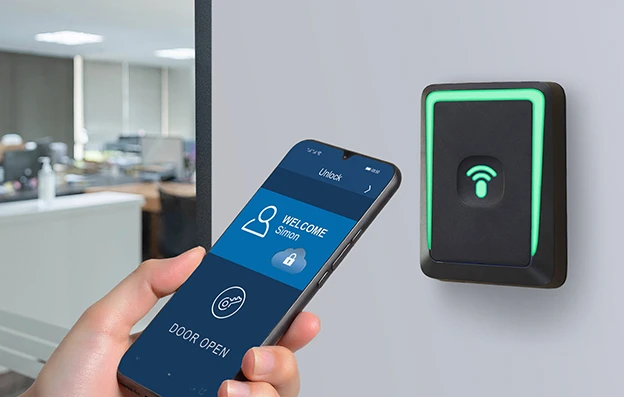
NFC Access Control Reader: Near Field Communication (NFC) replicates the intuitive "tap-and-go" motion of a standard physical card. Because an nfc access control reader requires a very short reading range (typically under 5cm), it guarantees user intent. The door opens only when the user makes a deliberate physical movement to present their device to the terminal.
BLE Access Control Reader Integration: BLE introduces the concept of long range reader access control. Operating at distances up to several meters, a BLE access control reader enables hands-free entry. This capability is highly valued in modern corporate lobbies, automated parking gates, and industrial warehouse zones where employees may be carrying equipment or operating machinery and cannot stop to tap a card.
While RFID and mobile credentials are ideal for permanent staff, they are inefficient for temporary contractors, delivery drivers, and one-time visitors. Integrating a QR code reader access control system solves this friction point entirely. Understanding the top benefits of using QR code door access control in modern buildings allows facility managers to transition to a completely digital, automated visitor workflow without sacrificing security.
Dynamic Digital Assets: Through an integrated access control qr code reader, system administrators can generate time-restricted QR tokens and distribute them instantly via email or messaging applications.
Granular Expiration Controls: These dynamic credentials can be programmed to work only for a specific shift, a single entry, or a precise two-hour window. Once the time window closes, the code self-destructs digitally, ensuring no lingering access capabilities remain.
Logistics and Supply Chain Automation: Incorporating a highly responsive barcode reader for access control at loading bays and freight entrances allows delivery drivers to present a shipping manifest barcode directly to the reader. This automates entry logging and warehouse routing without requiring human intervention at the gate.
For high-value zones—such as enterprise server rooms, research laboratories, and financial vaults—relying on a single authentication factor (what you have, like a card or phone) introduces operational risk.
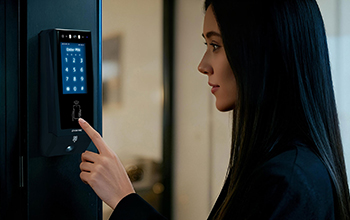
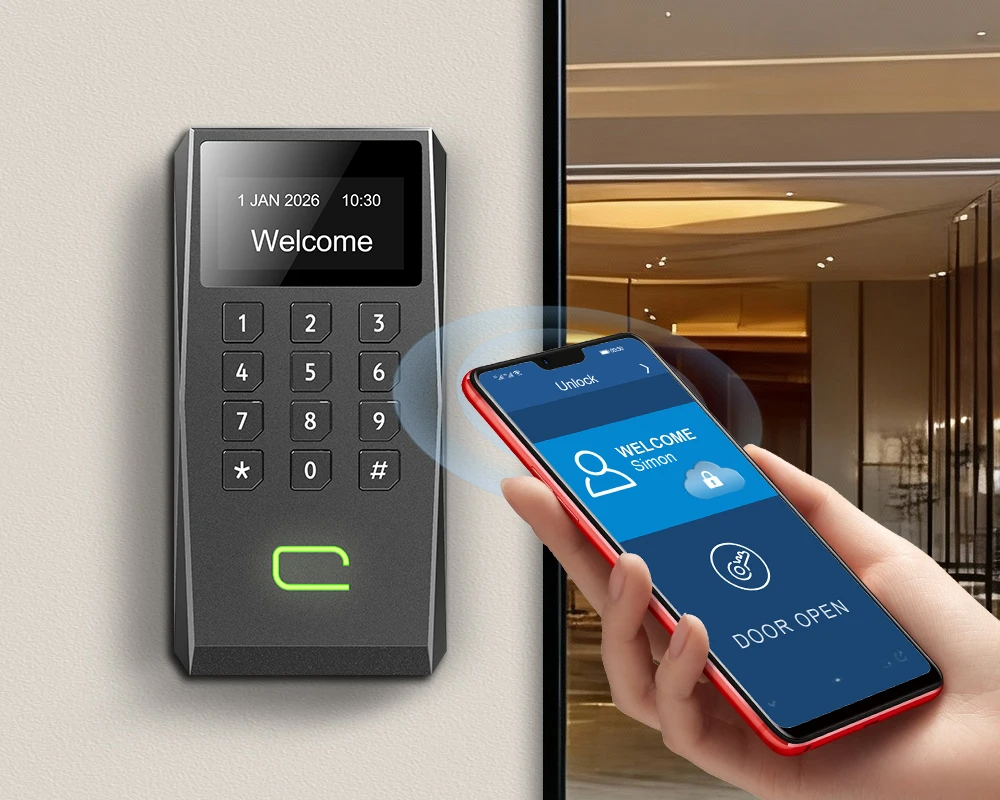
Deploying a keypad card reader access control device allows for true Multi-Factor Authentication (MFA). To gain entry to restricted infrastructure, users must complete a two-step verification sequence: an encrypted RFID/NFC scan followed by entering a unique, personalized PIN code via a secure keypad reader access control interface.
[block1]
Selecting the right authentication technology on the front end is meaningless if the data link between the access control reader and the door controller remains unprotected. Historically, the security industry relied on the legacy Wiegand interface to transmit credential payload data.
Wiegand remains highly compatible with most access controllers on the market. CIVINTEC and Cidron access control readers support wiegand 26~1024bit which is fully programmable by using CIVINTEC configcard software.
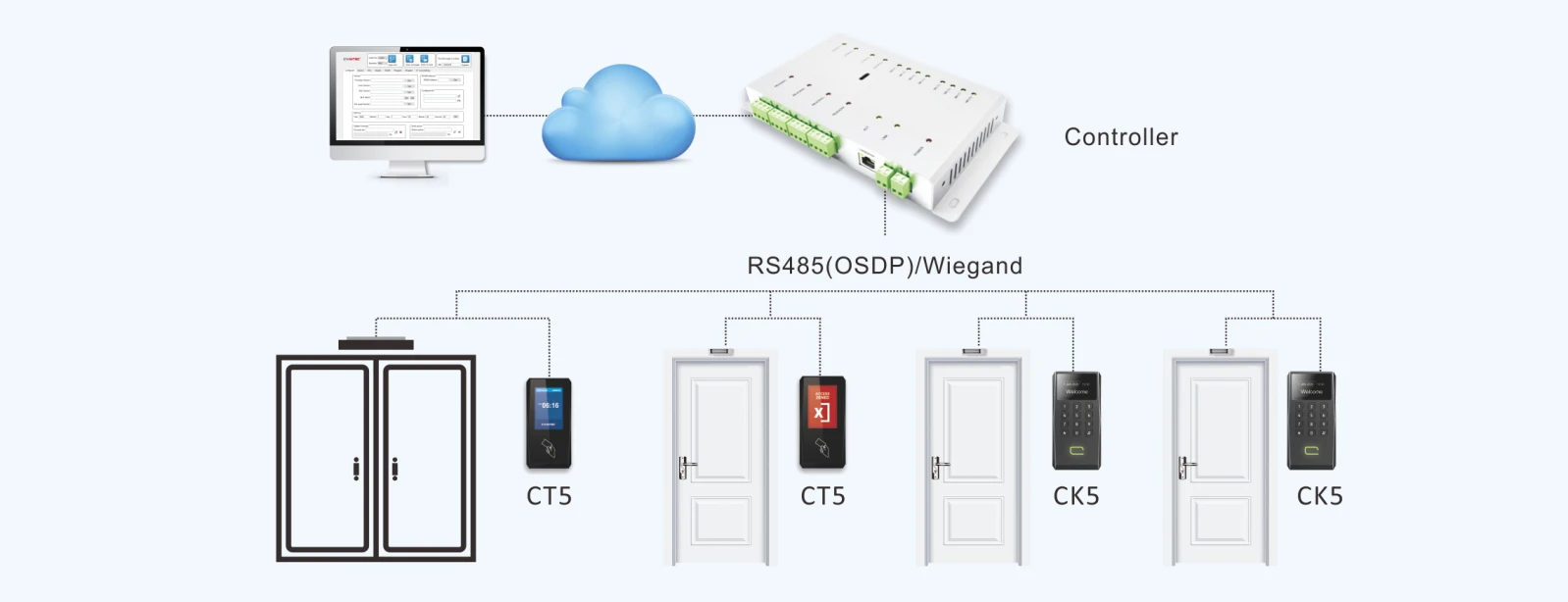
CIVINTEC and Cidron access control readers support the Open Supervised Device Protocol (OSDP), configured over an RS485 serial bus network. Conforming to the SIA (Security Industry Association) v2.2 standard, OSDP brings several critical enhancements to security and access control systems:
Secure Channel Encryption: OSDP uses AES-128 encryption to completely secure all data flowing from the reader to the controller, rendering data sniffing tools useless.
Bi-Directional Communication: Unlike Wiegand, which only transmits data in one direction, OSDP allows the controller to actively monitor the health, configuration, and online status of the door access control reader in real time.
Supervised Tamper Detection: If an unauthorized person attempts to detach an OSDP reader from the wall or cut the communication line, the controller instantly detects the break in communication and triggers a high-priority system alarm.
Simplified Wiring Topologies: An OSDP installation utilizes a 4-conductor daisy-chain configuration rather than the bulky, multi-conductor homerun wiring required by Wiegand. This shift significantly reduces material overhead and labor costs during access control card reader installation.
CIVINTEC CT5/CK5 reader supports Wiegand and OSDP protocols, making it compatible with most access control panels and security systems, seamlessly integrates into any club management ecosystem.
A successful deployment requires balancing security compliance with physical aesthetics and environmental resilience. CIVINTEC addresses these divergent needs by providing distinct hardware form factors tailored to specific structural environments.
Architectural constraints often dictate the placement of access control readers. For glass-front boardrooms, aluminum window frames, and narrow entry pathways, standard square readers are physically too wide to install cleanly.
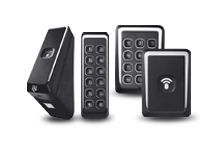
Cidron Slim Mullion Design: Engineered specifically for space-constrained spaces, this narrow-profile housing mounts directly onto standard door frames and metal mullions without sticking out or disrupting architectural lines.
Cidron Standard Design: Designed to mount directly on the wall, this variant is ideal for heavy-traffic main entry points, exterior drywall, and masonry installations where a broader, more robust physical footprint is needed.
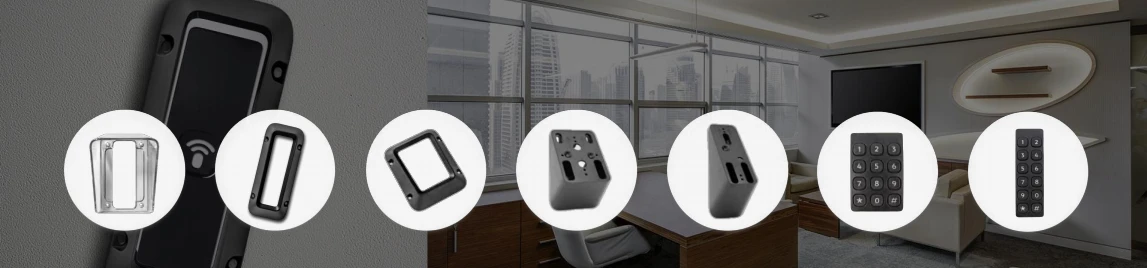
Cidron Family reader is designed with various accessories to facilitate installation in all kinds of occasions. The Cidron reader vandalization protection protects the reader and helps it withstand violence by absorbing and redirecting external forces away from the reader. Distance plate with different angled enables smooth and flexible installations, and increase accessibility as well as visibility of the Cidron reader keypad. The tamper switch tray can help Cidron reader suitable for uneven wall installation and all kinds of mounting surface installation.
When projects demand advanced user interaction, customized graphic interfaces, or multi-factor confirmation loops, static plastic readers are no longer sufficient. CIVINTEC's specialized reader family bridges the gap between classic card scanning and interactive edge processing.
The CIVINTEC CK5 OLED access control reader is designed for environments that require both high durability and real-time visual feedback.
High-Contrast OLED Matrix: The integrated display provides immediate, clear operational guidance to the user, displaying custom messages such as "Access Granted," "Access Denied," "System Armed," or localized multilingual text instructions.
Mechanical Keys: The physical 4x4 keypad matrix is designed for high-frequency tactile use, making it ideal for facilities where staff frequently wear protective work gloves or where physical push-button verification is preferred for durability.
Multi-technologies Reading Core: Beneath its rugged exterior, the CK5 combines an access control RFID reader engine with high-speed mobile scanning chips, handling physical smart cards and smartphone mobile credentials on a single reader platform.
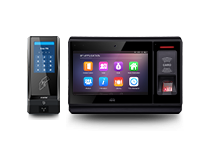
For modern corporate centers, luxury residential spaces, and high-tech smart buildings, the CIVINTEC CT5 PIN code reader offers an elegant, adaptive design.
Universal Credential Processing: The CT5 functions as an all-in-one hub. It is a premium smart card terminal, a responsive proximity reader access control engine, a high-speed mobile entry point all contained within a single sleek housing.
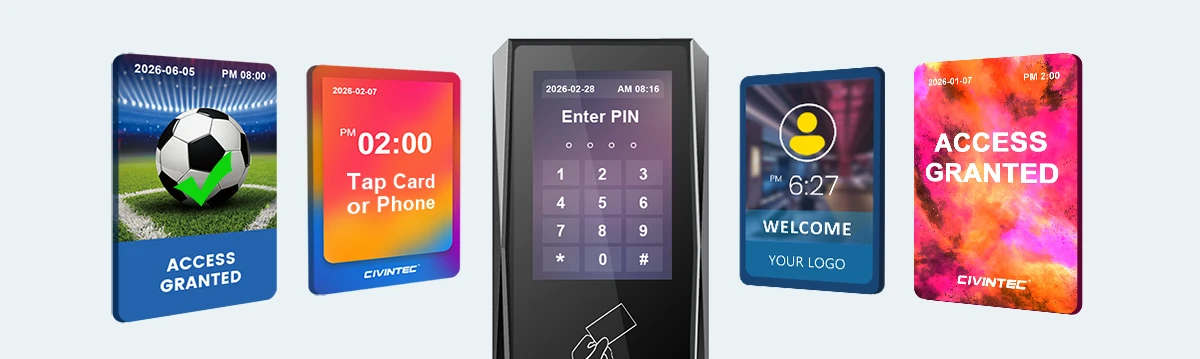
Customizable Touch UI: Linux based touch screen/display access control reader features a customizable interface with tailored text, icons, and audio feedback - including adjustable buzzer and speaker volume. When a member approaches, the screen can display welcome messages, access instructions, allowing staff to visually confirm identity. This allows clubs to set intuitive prompts such as “Welcome” or “Access Denied – Membership Expired,” providing clear visual and audible guidance for every visitor, and delivering a refined and modern access experience—elevating both security and aesthetic impression in premium fitness and club environments.
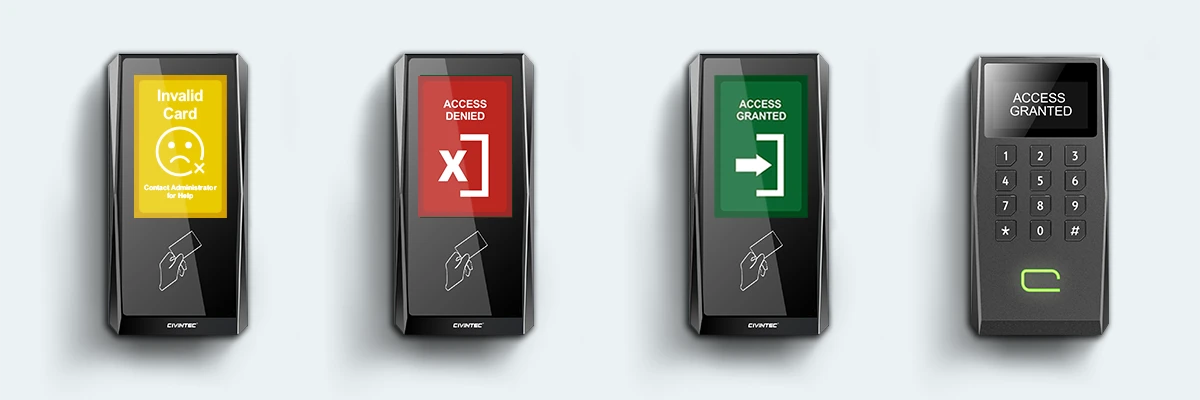
Dynamic Visual Communication: A clear, responsive touchscreen guides users seamlessly through authentication steps — whether tapping a card, entering a PIN, or using mobile credentials. Icons, visual feedback, and customizable screens enhance usability for all age groups.
A member approaches the touchscreen terminal. The screen lights up, showing the club logo and a prompt to “Tap Card or Phone.” After a quick NFC tap, the screen displays: “Access Granted — Welcome” The door unlocks. For added security after hours, the same screen can switch to require PIN verification following the card tap.
Display real-time messages security alerts directly on the screen — enhancing both communication and member engagement. Failed access attempts can trigger screen alerts or silent alarms, adding a visible yet discreet security layer.
When acting as a procurement manager or lead system designer for a large-scale project, your choice of access control card reader manufacturers directly impacts your project's implementation timeline and long-term return on investment. Use the following technical evaluation framework to select the right reader configurations for your facility:
Analyze who will be passing through each entry point. If a gate experiences heavy traffic during morning shift changes, avoid technologies with longer processing delays. Optimize your deployment by selecting the right technology for each specific role:
Corporate Employees: Assign NFC reader access control or high-frequency DESFire cards to ensure sub-second validation speeds.
Maintenance & Facilities Teams: Deploy long range reader access control utilizing BLE parameters, allowing workers to move freely through internal service corridors without having to put down materials to present a badge.
Transient Guests & Contractors: Implement terminals featuring a dedicated qr code reader for access control, keeping temporary users separated from your permanent credential pool.
Hardware longevity depends on matching structural specifications to physical installation environments.
Exterior Perimeters: Specify readers with an IP65 or higher ingress protection rating and UV resistance to protect against severe weather and strong UV-ray. Ensure the units feature fully potted internal electronics to eliminate humidity ingress and damage.
Interior Executive Wings: Prioritize sleek, minimalist aesthetics. Choose slim mullion profiles that fit cleanly onto architectural glass mount structures without requiring bulky modification plates.
Never compromise on your system's data integrity. Ensure your chosen hardware meets modern security standards:
Mandate AES-128 Encryption: Confirm that both your wireless card-to-reader link and your mobile app interactions use verified Advanced Encryption Standard protocols.
Enforce OSDP Compliance: Require that all newly deployed readers connect to door controllers via an encrypted RS485 OSDP secure channel.
[block12]
Designing a high-performance security and access control system requires looking beyond simple lock-and-key mechanisms. Modern properties demand an intelligent, multi-layered edge infrastructure capable of adapting to new authentication technologies as they emerge.
By partnering with professional access control card reader manufacturers like CIVINTEC, facility managers gain access to an agile, secure hardware ecosystem. Combining the uncopyable security of MIFARE DESFire with the flexible convenience of NFC/BLE mobile wallets, dynamic QR codes, and customizable interfaces like the CK5 and CT5 series allows you to build a security framework that protects your physical assets while respecting your users' time. When your perimeter is secured by bank-grade encrypted hardware, your smart building is fully prepared to handle the digital demands of tomorrow.


 Home >
  Share
Share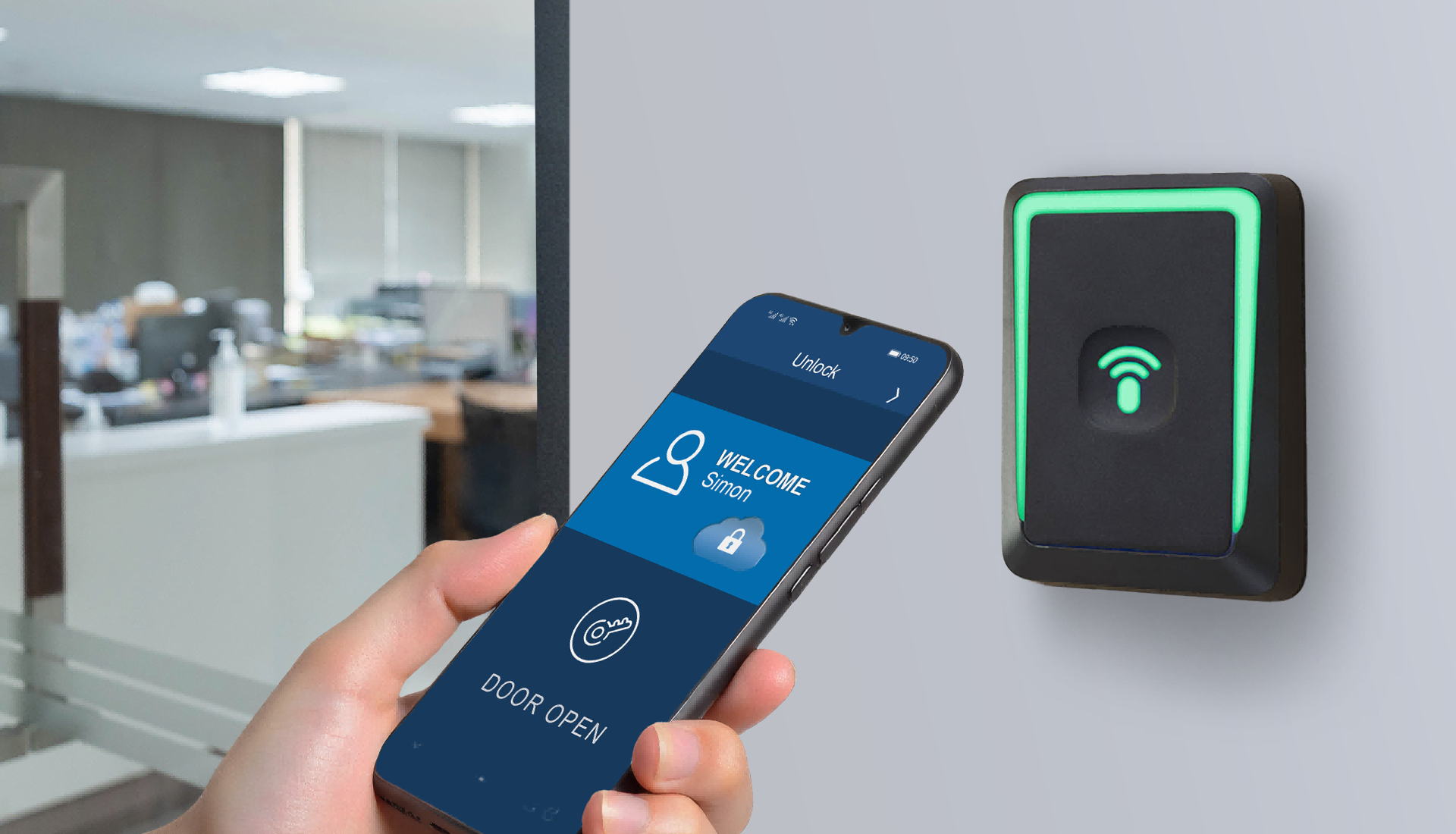





 Contact Us