

-

Applications

Industries

 OEM & ODM Service
 Development Service
 Download
 Technical support
 Warranty & RMA
 FAQS
FAQS
 My Community
 Who Is CIVINTEC
 Why CIVINTEC
 News & Express
 Cooperation





 Sep 17, 2026
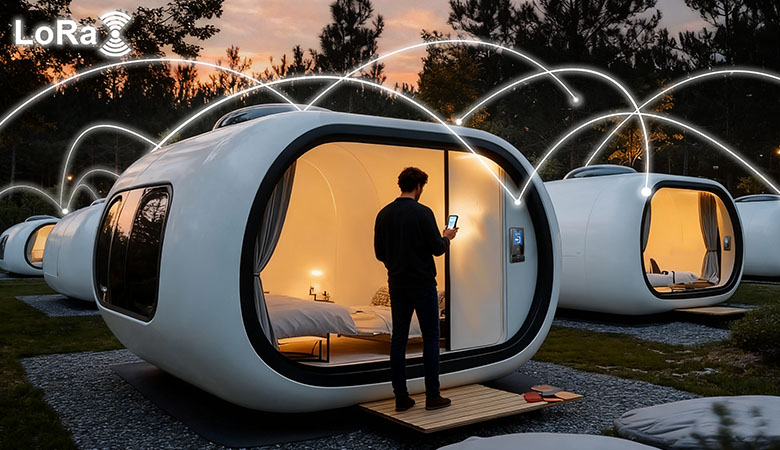
A guest arriving at an eco-resort after reception closes needs more than an unlocked cabin. The route should be easy to find, the room should be ready for use, and booked amenities should work without a staff member visiting each building. For the operator, the same experience should avoid leaving every light and facility running throughout the night.
A Hotel Access Control System can connect authorized entry to the controlled use of facilities. CIVINTEC supplies the access control hardware and integration tools for this approach. With customer management software and suitable external controllers, an accepted credential can initiate a defined lighting or room-equipment action, while booking rules determine which services the guest may use.
For hotel equipment manufacturers, resort developers, and system integrators, the practical question is how to connect these functions reliably. This article focuses on automated facility management across cabins, campsites, guest rooms, and shared amenities, from the first arrival to checkout and maintenance.

A campsite access control system must accommodate a different layout from a conventional hotel corridor. Accommodation, washrooms, recreation rooms, and service buildings may be separated by outdoor paths. A valid stay does not necessarily include every facility, and a day visitor may hold a recreation booking without overnight accommodation.
Treat each facility as a resource with its own permission and operating rule. Room access might follow the stay dates, while a private shower suite follows a shorter reservation. A maintenance credential may permit access to a plant enclosure without activating any guest services. This separation makes automation useful without creating a single pass that enables everything.
CIVINTEC's Hotel and Campsite Access Control Solution describes multi-credential access and the connection between door control and room facilities. It provides an application reference for hospitality projects; the exact equipment sequence and business rules still need to be specified for the property.
The booking or property management system establishes the guest's entitlement. Integration software translates that entitlement into permissions and facility commands. The access control terminal reads the credential and participates in the configured authorization process. A compatible relay interface or equipment controller carries out the permitted action.
This distinction matters during procurement. An SDK provides a route for software integration, not a complete hotel management platform. Likewise, an access control relay provides a switching or control interface, not unlimited electrical power for lighting circuits, heaters, or appliances. The equipment supplier must confirm the appropriate interface, isolation, and load handling.
Consider a planned deployment with reception in one building, detached guest cabins, and a shared recreation pavilion. Before arrival, the operator's software can associate a guest with a specific cabin and booked services. The integration should activate only the approved access periods and resources, rather than distributing a permanent shared code.
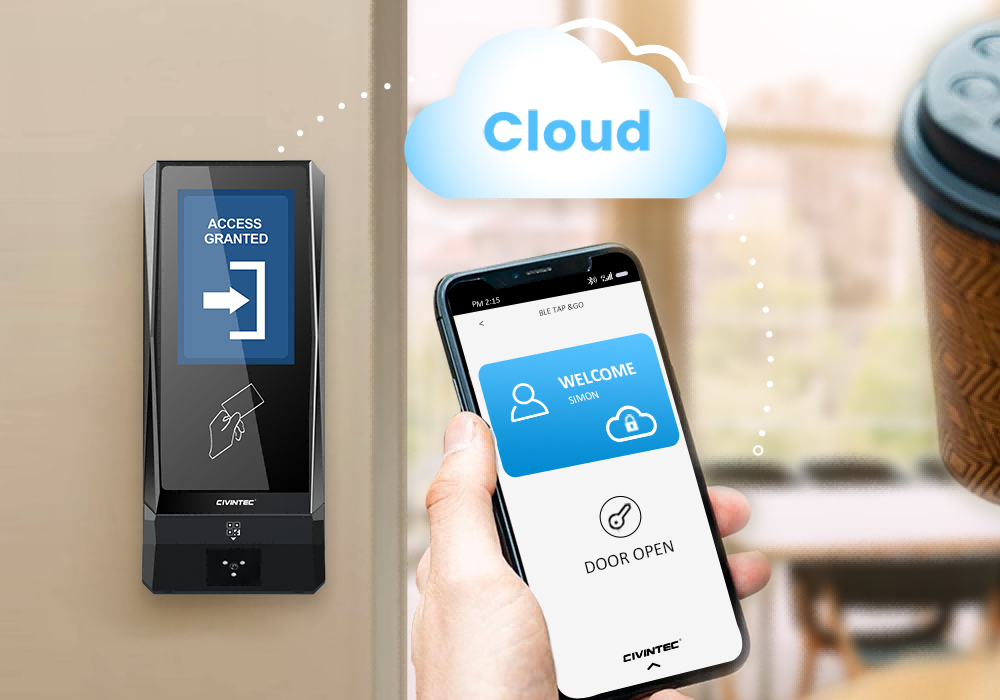
At the entrance, a compatible RFID card, NFC/BLE mobile credential, or configured QR code can support self-service access. Guests should receive clear instructions about where the credential works and how to request assistance. A booking confirmation email is not automatically an access credential; issuance and validation must form part of the integrated workflow.
An accepted entrance event can be used by the facility-control integration to request lighting for a cabin approach or arrival area. Define which lights respond, whether a daylight condition applies, and when the temporary lighting should return to its normal schedule. Daylight detection requires a suitable external input or the facility platform's scheduling logic.
Arrival lighting should complement the property's normal route lighting, not replace it. A guest who loses a credential or arrives at the wrong entrance still needs a usable route. Keep essential circulation and emergency lighting independent of discretionary guest activation so a rejected credential does not leave someone in darkness.
Where arrival support is required, CT11 or CT10 can provide VoIP audio assistance as part of a configured communication solution. The operator still needs an available person or service to answer. Unattended entry removes the need for a staffed desk at each doorway, but it does not remove responsibility for guest support.
[block1]
Room automation works best when it responds to several defined states: reserved, ready, occupied according to the property's chosen detection method, temporarily vacant, and checked out. An accepted access event is useful within this logic, but it does not establish all those states by itself.
For example, the first authorized entry could request a welcome-lighting scene from an external room controller. The controller can then manage the relevant lighting channels. Subsequent entries should not repeatedly reset a guest's preferred lighting or restart equipment unnecessarily. Decide whether the action applies once per stay, once per room session, or at every valid entry.
A Hotel Access Control System can provide an authorization event that an integrated room-management platform uses to enable comfort settings. Air conditioning, ventilation, multimedia, and controllable sockets require compatible equipment interfaces. Their operating limits remain with the room-control system and the equipment manufacturer's requirements.
Avoid treating checkout as a command to remove power from the entire room. Refrigeration, essential services, and equipment with controlled shutdown requirements may need continued supply. Separate discretionary loads from services that must remain available, and give housekeeping a suitable service state while preparing the accommodation for the next arrival.
CIVINTEC's meeting room reservation solution illustrates the related principle of linking a reserved period and authorized entry to lighting and other room facilities. A resort can adapt that integration concept to a booked lounge or activity room, with its own operating rules.
A family may enter together using one credential. One person may later leave while others remain inside. Therefore, access events alone should not decide that a cabin is empty or that its lights can be switched off. Use a suitable occupancy strategy and guest controls where the intended automation depends on actual presence.
This is particularly important in accommodation where guests expect privacy and uninterrupted comfort. The integrator should explain which inputs determine room state, how long transitions take, and what happens when the inputs disagree. A simple, understandable control sequence is easier to maintain than an ambitious sequence built on unreliable assumptions.
Shared facilities give automated facility management a practical role beyond the guest room. A washroom block may be available throughout a stay, while a private sanitary unit, sports area, or recreation room may require a separate reservation. The system should distinguish access to the building from permission to activate a particular service.
The following examples describe integration designs to specify and test, rather than functions supplied by an access control terminal alone.
| Facility | Authorized action | External control requirement |
|---|---|---|
| Private sanitary unit | Admit the booked guest and enable the approved service session | Suitable service controller, session rules, and local user controls |
| Recreation room | Unlock during the booking and request an appropriate lighting scene | Room controller with a defined session-end sequence |
| Outdoor sports area | Admit authorized users and request scheduled lighting | Lighting controller and separate route-lighting provision |
| Laundry room | Permit entry and identify eligibility for a machine session | Appliance interface and customer billing or entitlement software |
| Guest cabin | Release the entrance and request the configured welcome action | Room controller with an independent occupancy strategy |
If a campsite charges for a facility, the customer platform must establish that the service is paid for or included in the stay. The terminal can then participate in the configured permission and activation process. RFID and QR code support do not, by themselves, provide bank-card acquiring, payment settlement, or a complete billing service.
For timed services, specify how a session starts, pauses if supported, and ends. Prevent repeated presentations from creating duplicate charges or overlapping sessions. A request to stop a service must follow the equipment's approved control sequence. The guest interface should make the remaining entitlement and any support option understandable without requiring a visit to reception.
The CIVINTEC facility control solution provides the hardware context for connecting access permissions with locks, lighting, and external facilities. Customer software supplies the booking, charging, and operating policies needed to turn those interfaces into a usable hospitality service.
Terminal selection should follow the interaction required at the location. A reception entrance may need assisted access. A remote amenity door may only need credential verification and clear feedback. Installing the same configuration everywhere can add functions that the location does not use while overlooking the interfaces it actually needs.
The comparison below concentrates on verified differences relevant to this application. Confirm the ordered configuration, QR code option, network connection, and available relay interfaces before finalizing the design.
| Selection point | CIVINTEC CT11 | CIVINTEC CT10 | CIVINTEC CT9 PRO |
|---|---|---|---|
| Main role | Facial recognition access control terminal | Credential-based access control terminal with camera | Credential-based access control terminal |
| Interface | 3.5-inch touch screen; Linux | 3.5-inch touch screen; Linux | 3.5-inch touch screen; Linux |
| Credential options | Face; RFID (125kHz & 13.56MHz); NFC/BLE mobile credentials; optional QR code; PIN | RFID (125kHz & 13.56MHz); NFC/BLE mobile credentials; optional QR code; PIN | RFID (DESFire with SAM); NFC/BLE mobile credentials; optional QR code; PIN |
| Camera function | Facial recognition; confirm project capture settings | Supported photo capture on RFID card and QR code reads | No built-in camera |
| Assistance | VoIP audio intercom | VoIP audio intercom | No built-in VoIP intercom |
| Facility integration | Customer software and suitable external control interfaces | Customer software and suitable external control interfaces | Customer software and suitable external control interfaces |
| Location to evaluate | Assisted main entrance or controlled staff access | Amenity entrance needing credential-linked photos and audio assistance | Cabin or shared facility entrance using credential verification |
PIN configuration: CIVINTEC terminals support basic PIN setup in standalone mode. Assigning different PINs to individual guests or using dynamic PINs requires the client's cloud software; these advanced workflows are not available in standalone mode.
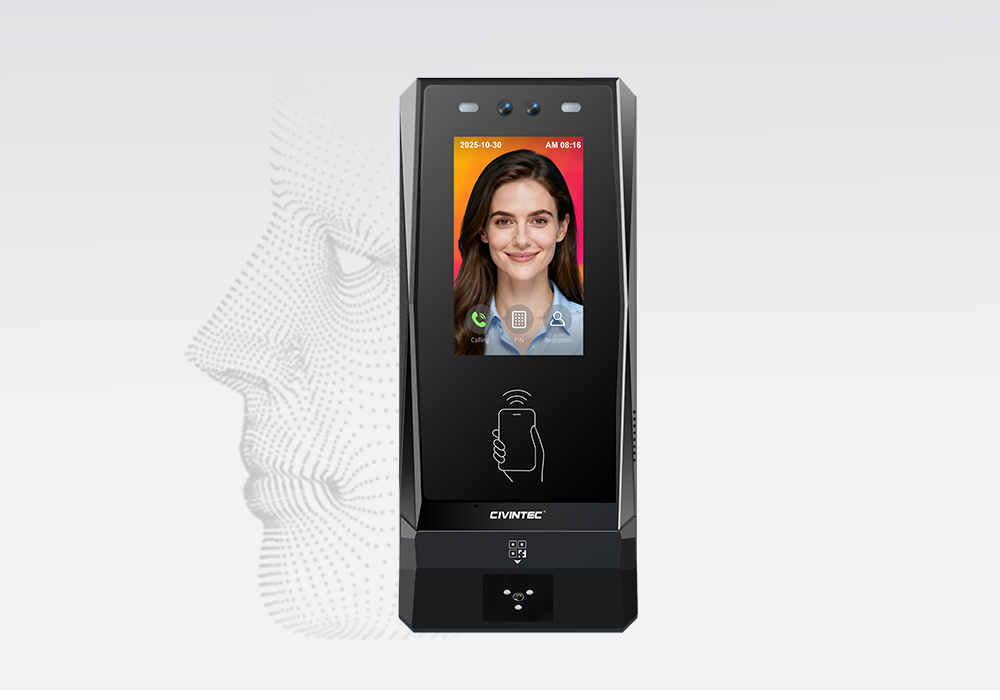
Evaluate the CIVINTEC CT11 access control terminal where facial recognition serves a defined operational need, such as controlled staff access or an agreed guest enrollment workflow. Its VoIP audio function can support assistance at entrances. Facial recognition should remain an intentional project choice, with suitable handling of enrollment and an alternative credential route.
The CIVINTEC CT10 access control terminal suits projects requiring credential-based access, supported photo capture on RFID card and QR code reads, and VoIP audio assistance. Confirm capture triggers, storage, and transfer settings. Its camera should not be described as a facial recognition function or assumed to photograph every person entering a facility.
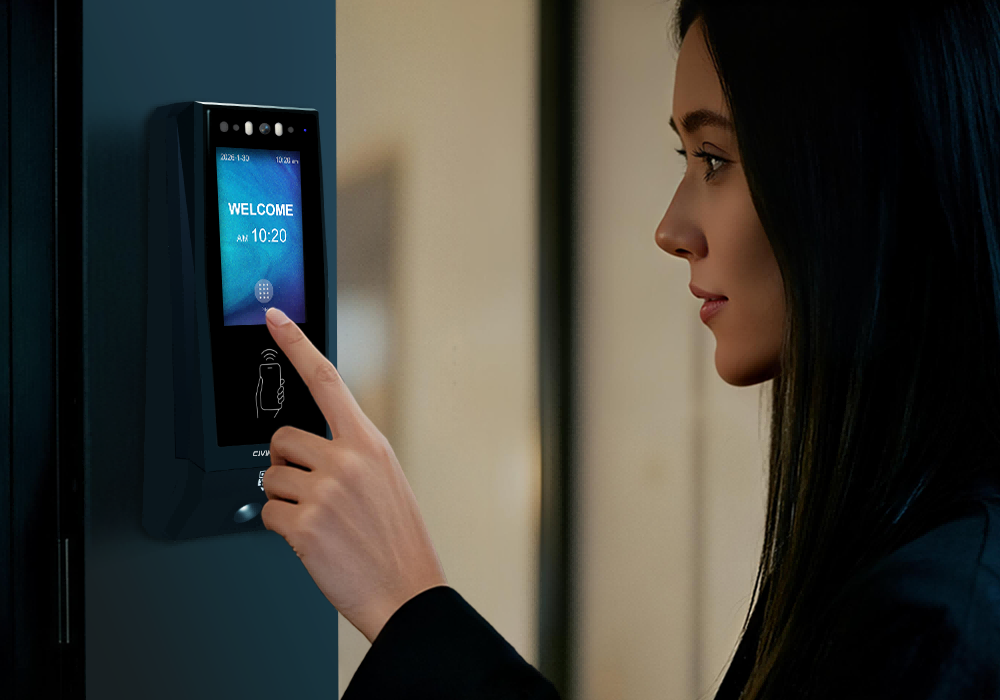
The CIVINTEC CT9 PRO access control terminal is an option for distributed doors where RFID (125kHz & 13.56MHz), NFC/BLE mobile credentials, optional QR code, or PIN entry meets the requirement. Provide a separate assistance method where needed. Across the terminal selection, basic PIN setup must be distinguished from advanced per-user or dynamic PIN workflows requiring customer cloud software.
Checkout is an important transition for a Hotel Access Control System, because access rights and equipment requirements change at different times. A departing guest's room permission may end before housekeeping finishes preparing the cabin. A luggage collection arrangement may also require limited access without restoring the entire stay entitlement.
Define a service workflow for these situations. The customer platform should distinguish the guest's ended stay from a staff member's authorized cleaning visit. A housekeeping credential can request a suitable working-lighting state through the integrated room controller, without being treated as a new guest arrival or restarting a chargeable amenity session.
Maintenance needs a separate rule. If a shower unit or room appliance is unavailable, remove it from guest authorization while allowing approved service access. The booking interface should communicate that the facility is unavailable. An access control terminal cannot determine that a repair is complete; an authorized operator or integrated maintenance process must release it back into service.
For a campsite access control system, seasonal closure adds another transition. Buildings may retain staff access while guest services are suspended. Specify how permissions, equipment schedules, and remote commands behave during closure, then test reopening before the next arrivals. This makes the same infrastructure useful throughout the operating year rather than only during normal occupancy.
When a credential can activate a paid service or open a guest cabin, its permissions deserve the same attention as its convenience. Separate staff service rights from guest entitlements, and revoke a lost or replaced credential through a defined process when issuing its replacement. A canceled stay should not remain entitled to a private facility simply because its original credential still exists.
For RFID deployments using DESFire EV1/EV2/EV3 credentials, AES encryption and correctly configured protected-application authentication can resist misuse based only on copied card identifiers. Reading a public card UID alone does not provide that protection. Key management, card configuration, and authentication behavior must be confirmed as part of the deployment.
Credential protection also does not prevent someone lending a valid card, or another person following an authorized guest. Nor does it automatically secure the terminal-to-server connection or external equipment links. Evaluate those communication paths separately and restrict who may issue remote equipment commands in the customer platform.
Keep the wider hospitality-security context distinct from this article's facility-automation focus. CIVINTEC's hospitality access control overview discusses guest and staff access across hotel areas. Here, the design priority is what an authorized action should enable, for how long, and under whose control.
Campsites and eco-resorts combine exposed entrances with buildings that may have different network and power arrangements. Survey each installation location before selecting its terminal variant. Ethernet or a supported wireless connection must be chosen against actual site coverage and the traffic required by the application. Do not assume one connection option is standard across every model.
Confirm the enclosure rating and installation requirements for the ordered hardware. Rain exposure, condensation, cleaning methods, and cable entry details deserve separate attention. An ingress-protection rating should not be expanded into a promise of resistance to steam, corrosive cleaning chemicals, or every outdoor condition.
Specify separately what happens if the internet connection, local network, customer server, or electrical supply fails. Approved local credential behavior, where configured and supported, does not mean online booking changes or immediate remote revocations remain available. Power interruption requires its own supply and backup design.
Facility sessions need an equally clear fallback. Decide whether an already authorized session can complete locally and how a newly requested service should behave if its entitlement cannot be checked. On reconnection, prevent delayed or repeated commands from starting an expired session. Test event reconciliation and equipment state rather than assuming that a restored connection resolves everything automatically.
Begin with one cabin and one shared facility before expanding to the whole property. The pilot should involve the equipment manufacturer, software integrator, and the staff who handle guest complaints and maintenance. Each party needs to know which component owns a failed permission, an equipment command, and the physical result.
Test a complete stay, including an early arrival, an approved extension, a lost credential, and checkout. Include a family with more than one authorized guest so the room-control logic is not built around a single-person assumption. For a shared facility, test cancellation, repeated credential presentations, and a session requested just before closing time.
Check the physical result as well as the software event. A command recorded as sent does not establish that a light switched on or that a valve reached its intended position. Where confirmation is important, specify the appropriate feedback input or equipment-status integration. Define an escalation path for a command that receives no confirmation.
An eco-resort can evaluate discretionary lighting hours, facility operating time, support calls, and staff visits before and after a pilot. Compare similar booking levels and operating conditions. Energy savings require appropriate consumption measurements; credential counts alone cannot establish how much electricity or water was saved.
Use those observations to refine the rules. A lighting timer that repeatedly expires too soon may increase support calls, while an overly generous session may waste resources. The useful outcome is a dependable guest experience with better-controlled facility use, supported by site evidence rather than a promised universal savings percentage.
[block2]
A CIVINTEC Hotel Access Control System can provide the hardware foundation for connecting guest authorization with room and shared-facility use. For campsites and eco-resorts, the strongest applications combine convenient credentials with carefully defined lighting, equipment, and session-control workflows.
Successful automated facility management depends on clear integration responsibilities. Choose the terminal for the location, define the external equipment interface, and test both normal operation and service interruptions. This gives manufacturers and project teams a practical basis for scaling a solution without overstating what the access control hardware does on its own.
Initiate Technical Consultation with CIVINTEC to discuss your accommodation layout, facility interfaces, and customer software requirements. Explore Product Specifications to compare terminal options for the project.


 Home >
  Share
Share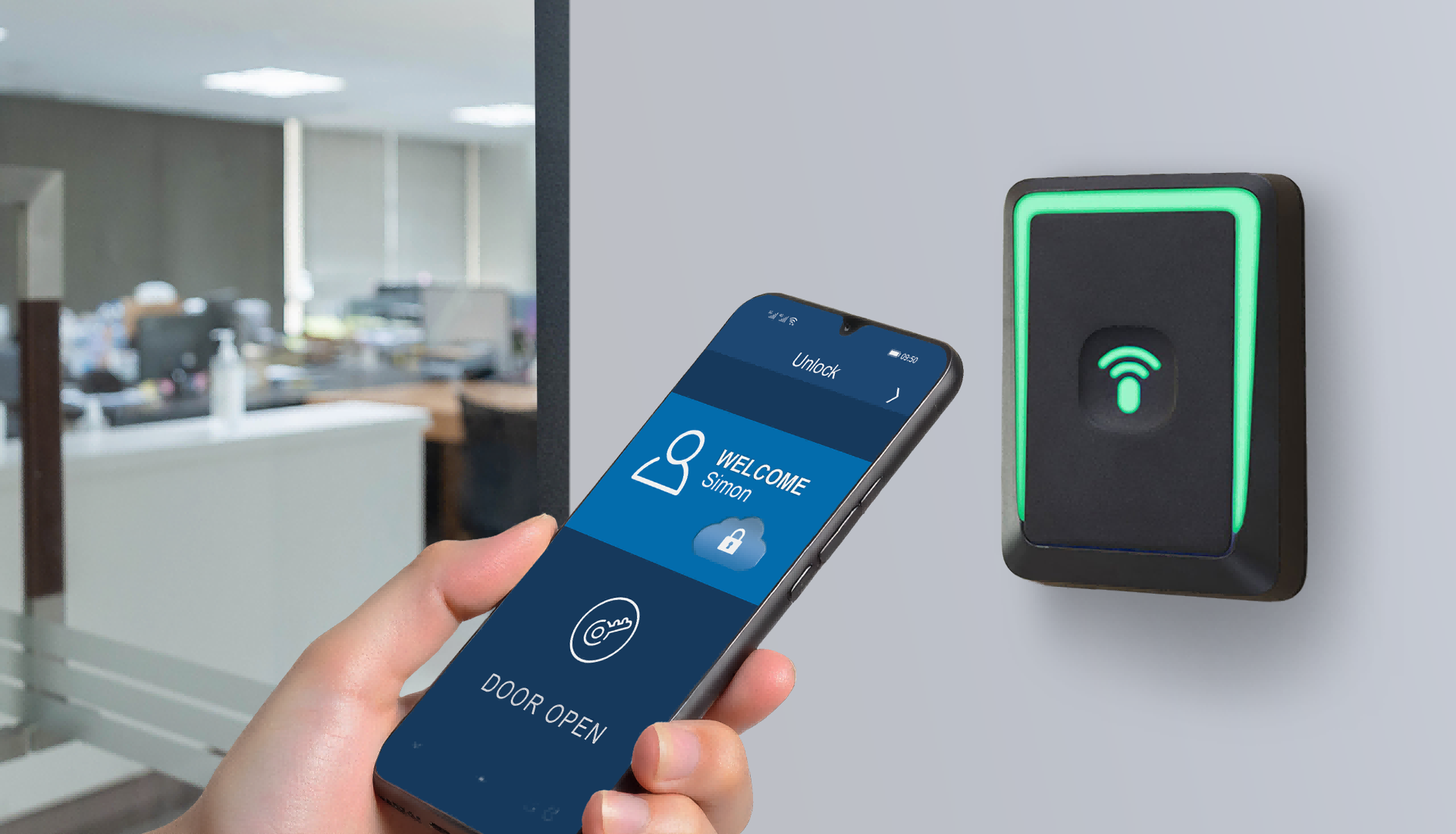



 Contact Us