

-

Applications

Industries

 OEM & ODM Service
 Development Service
 Download
 Technical support
 Warranty & RMA
 FAQS
FAQS
 My Community
 Who Is CIVINTEC
 Why CIVINTEC
 News & Express
 Cooperation





 Oct 09, 2026
A machine room in a factory, a medication store in a hospital, and a network closet on a university campus have different owners and different operating rules. Yet they pose the same access question: who is allowed to reach this asset, at this location, for this purpose, and for how long? A building-wide badge alone rarely answers it. It may open the perimeter while leaving the most important equipment dependent on shared keys, informal handovers, or permissions that are never reviewed.
Effective asset access control links a verified person to a defined access point and a time-bound permission. It can provide a reliable starting record for an investigation or service workflow. It does not, by itself, prove which machine was operated, whether an item was removed, or whether a procedure was completed. Those facts require suitable sensors, controllers, inventory data, and customer management software.
CIVINTEC develops access control terminals and readers that can serve as the physical identification and control layer in this architecture. The same hardware family can support very different industries when the integrator configures the right credential, zone rule, controller interface, and event workflow. This guide lays out those shared design decisions, then applies them side by side across six industries.

A useful design starts with a resource register rather than a device catalog. List each room, cabinet, enclosure, workstation, or equipment interface that needs a controlled boundary. Give every resource an owner who can approve access and an operator who can review the resulting events. Group resources by operational risk, not simply by floor or department.
Next, distinguish three decisions. Identification asks which credential or person is presented. Authentication checks whether the credential is valid under the selected method. Authorization decides whether that authenticated identity may pass this boundary now. A valid credential should not be treated as universal permission. A maintenance specialist may enter a plant room for a scheduled task but should not inherit authority over every panel inside it.
For equipment access control, decide whether the control point is a door, a cabinet, an enable input to a separate machine controller, or a combination. CIVINTEC’s facility control solution describes how a terminal can participate in authorized equipment access. A relay or I/O signal may form part of that design, but the external controller remains responsible for machine safety logic and electrical isolation. The project must confirm interface ratings, fail-state behavior, emergency procedures, and local requirements before deployment.
Finally, define what an event record means. A terminal can record an accepted or rejected access transaction and associated time according to its configuration. It is not an inventory system. To show actual tool checkout, production use, medication withdrawal, or asset movement, the customer platform must correlate the access event with work orders, cabinet contacts, transaction systems, or other evidence.
[block1]
The following examples use the same planning lens—person, protected resource, allowed period, credential, and evidence—without assuming that one industry’s policy applies to another. CIVINTEC supplies the terminal/reader layer; site owners and integrators define the policy and connected systems.
A production floor may contain presses, test benches, automation cabinets, and maintenance tools. An employee’s right to enter the workshop does not automatically authorize starting a particular machine. Map each equipment group to an owner, authorized operator group, and shift or work-order window. A credential check at a machine interface can provide a distinct authorization step after the worker has entered the wider area.
CIVINTEC’s IoT facility-control case study illustrates a CT9 PRO-based equipment interface. In an engineered deployment, the terminal can present an authorization signal to a compatible external controller; that controller governs machine operation. Operators should be able to see whether a request was accepted, while supervisors review exceptions such as expired access or a contractor arriving outside the scheduled service period.
The industrial access control solution provides broader context for factories and hazardous zones. Use its scenario as a planning reference, not as proof that a badge alone enforces training, lockout/tagout, or safe machine state. Those controls must remain in the plant’s own processes and safety equipment.
A sensible pilot places the authorization point beside one machine group and asks operators to test ordinary shift changes, supervised training, maintenance handover, and an attempted start by an unassigned user. The resulting event review should show the difference between entering the workshop and requesting use of the protected equipment. If either record is ambiguous, fix the resource naming and approval workflow before scaling to more lines.
Hospitals need both rapid movement and narrow access to certain resources. A medication store, sterile-supply room, imaging-equipment area, and engineering plant room should not share a single staff permission. Assign each boundary to its clinical or facilities owner. Give staff access according to role and approved working period; use temporary permissions for external service teams with clear expiry and escalation paths.
At a medication-store door, a credential event can indicate who requested entry and when. It does not establish which supplies were removed. A pharmacy or inventory system must record the dispensing transaction. Similarly, a technician’s entry to an imaging service room does not prove that the device was maintained or returned to service. Keep access history and clinical/service records linked through the customer’s governed workflow, not conflated.
CIVINTEC’s healthcare access control case study discusses staff, visitor, and storage-area permissions. Each hospital should also define emergency egress, privacy, and infection-control procedures with its own specialists before selecting hardware or credential methods.
A useful first test is a shared service corridor leading to several restricted rooms. Confirm that a nurse, a pharmacist, a facilities engineer, and an escorted vendor each see only the doors needed for an assigned task. Review what happens when a shift overruns, a service appointment is cancelled, or urgent access is needed. Those cases expose permission gaps more quickly than a demonstration of normal entry alone.
A distribution center may separate receiving doors, high-value stock cages, battery-charging rooms, and vehicle dispatch offices. The same driver can be permitted to reach a loading bay without gaining access to inventory storage. Warehouse staff may need stock-cage access during a shift, while a service contractor only needs the equipment room for a booked repair.
Place readers or terminals where those boundaries can actually be enforced, then define short-lived roles for visiting carriers and contractors. An accepted event at a cage door can support an investigation, but it cannot substitute for a warehouse management system’s pick, pack, or stock-movement record. If the project needs a chain of custody, connect the two systems with deliberate identifiers and review rules.
For distributed sites, clarify whether a local decision must continue during network loss, what permissions remain cached, and when events synchronize. Do not promise that offline operation, remote updates, or alarm delivery will behave identically across all models and network designs; acceptance testing should establish the configured behavior at every location.
Loading areas also create practical identity problems. A dispatch appointment may belong to a carrier, but the person at the gate can change. The site therefore needs an issuance method that ties temporary access to an approved visitor and an expiry window. If trailer, pallet, or vehicle identifiers are also required, capture them through a connected logistics process; a reader that accepts a credential cannot independently verify the shipment behind it.
A campus has open circulation spaces but also research laboratories, equipment stores, IT rooms, and workshops. A student card may be valid for general buildings while lab access depends on enrollment, supervisor approval, training, and the relevant project period. Visiting researchers need carefully scoped access that ends with their engagement.
A door credential can keep an unauthorized person out of a lab; a separate authorization point can be considered for a shared instrument or cabinet. The research group should decide whether a specific instrument needs an additional booking or sign-out record. If so, customer software—not a terminal’s basic door event alone—must track reservation, use, and return.
CIVINTEC’s campus and education solution describes role-based access across multiple buildings. For asset security management, the critical step is to reduce a broad “campus access” right into resource-level rules that administrators can understand, grant, revoke, and audit.
Research permissions can change in the middle of a semester. Build a review point around project membership, supervisor changes, and equipment downtime rather than waiting for an annual card refresh. Where a shared laboratory contains equipment owned by different groups, label each access point clearly and keep the policy at the resource level. This avoids turning one approved experiment into an accidental permission for neighboring instruments.
Hotels, campsites, and leisure venues use a mix of public circulation, guest-only amenities, plant rooms, and staff equipment. A guest may have access to a booked cabin and a shared facility during a stay, while housekeeping, maintenance, and deliveries follow different schedules and routes. No single guest credential should automatically open service stores or equipment panels.
A guest’s accepted credential can trigger a defined action in a connected facility system, such as a permitted amenity entry or a room-ready workflow, when customer software and suitable external controls are integrated. It should not be described as proof that every room device is being monitored or managed by the terminal. The operator must decide which event is the authoritative record for bookings and which system handles equipment faults.
The CIVINTEC hotel and campsite automation article shows how access and facility-management workflows can meet. For an asset-focused deployment, extend that thinking to staff-only stores and shared equipment while preserving a clear separation between a guest entitlement and a technician’s maintenance authority.
Seasonal staff and rotating contractors are a particular challenge at remote leisure sites. Define permissions for the property, role, and employment or service period; then remove them when that relationship ends. During commissioning, verify that a booking cancellation, a room change, and a temporary facility closure update the customer platform as intended. A successful door read is only one step in that broader operational exchange.
A civic office, utility depot, or public-service facility may welcome visitors at reception yet protect communications rooms, archives, control cabinets, and service vehicles. The owner of each resource should specify who may enter, whether a second verification step is appropriate, and how a temporary exception is approved. A contractor servicing one cabinet should not receive a permanent pass to the full technical area.
For critical equipment, room entry and equipment operation are two separate permissions. A terminal can participate in the first or in an engineered authorization interface for the second; the customer’s controller and procedure determine whether the device may safely operate. An access log can help review who presented a credential, but it cannot independently verify the physical person beyond the selected authentication method or prove what happened inside the room.
CIVINTEC’s government-site access control article develops this distinction in detail. Use it as a reference for policy design, while allowing each facility to set its own approvals, audit retention, and emergency behavior.
The review process matters as much as the entry point. A facilities team should be able to show who granted a temporary right, what resource it covered, when it expired, and whether a denial or exception was investigated. Keep the event record legible to non-specialist reviewers without exposing more personal data than the site needs. Periodic recertification can then remove inherited permissions that no longer match an employee’s assignment.
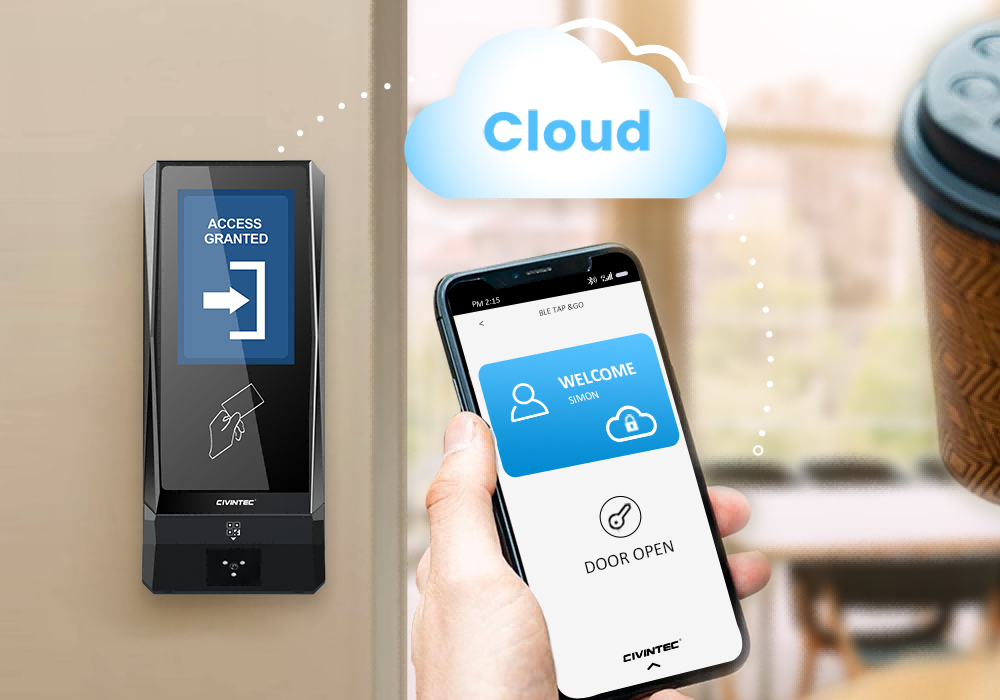
Credential choice should follow the boundary’s risk and operating pattern. RFID smart cards support familiar badge workflows; NFC/BLE mobile credentials can reduce dependence on physical cards; QR codes can suit planned temporary access when the project controls issuance and expiry; PIN can be convenient but should not become a shared master shortcut. The selected model and installed options determine which methods are available at a particular point.
For stronger RFID assurance, use appropriately configured MIFARE DESFire EV1/EV2/EV3 applications with AES-based authentication rather than treating a visible card identifier as the secret. Key management, provisioning, reader configuration, revocation, and the customer’s access policy matter. AES-capable cards do not make cloning impossible in every implementation, nor do they remove the risk of a borrowed legitimate credential. At higher-risk boundaries, consider a second independently managed factor where the project requires it.
A CT9 PRO configuration may include a secure access module slot for key-handling designs. That is a hardware option to assess, not evidence that a SAM module is already installed, provisioned, and enforcing a particular security policy at every site. Confirm variant, module, credentials, and commissioning steps in the project bill of materials.
The event model should answer: which credential was presented, at which boundary, at what time, with what decision, and under which permission state? Build retention, clock synchronization, privacy access, and exception-review rules around that record. Where the business needs more than entry evidence—for example a tool checkout or a maintenance sign-off—integrate the corresponding system and define how records will be reconciled.
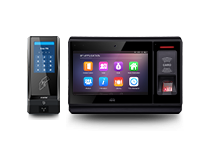
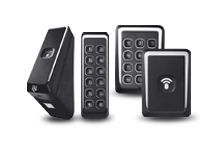
Model selection is less about putting the most complex terminal at every opening and more about matching verification to the job. A main staff passage, a high-value store, and a local equipment-control point may need different interfaces. CIVINTEC’s access control reader range can supplement terminal-led designs where a simpler reader is sufficient. The customer platform, controller, locking hardware, and network design remain part of the complete solution.
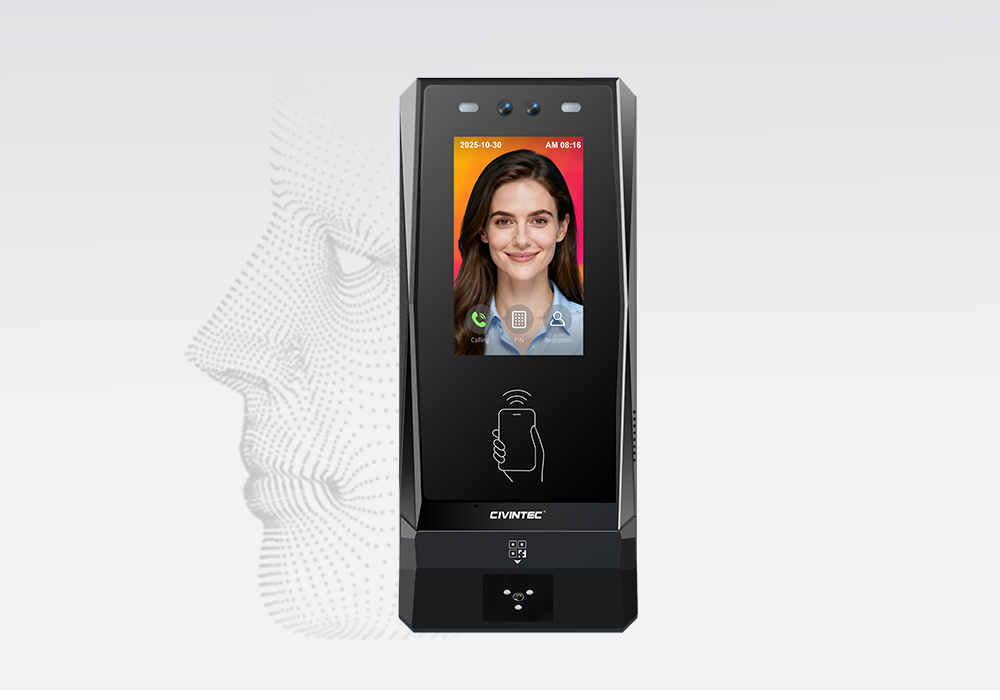
| Selection point | CIVINTEC CT11 | CIVINTEC CT10 | CIVINTEC CT9 PRO |
|---|---|---|---|
| Main role | Face-verification terminal for selected personnel boundaries | Credential-based terminal with camera | Credential-based terminal for doors or engineered facility-control points |
| Credential options | Face; RFID including DESFire; NFC/BLE; optional QR; PIN | RFID including DESFire; NFC/BLE; optional QR; PIN | RFID including DESFire; NFC/BLE; optional QR; PIN |
| Camera / audio | Face recognition and VoIP audio intercom | Configured event photo capture and VoIP audio intercom | No built-in camera or VoIP intercom |
| Product page | Explore CT11 | Explore CT10 | Explore CT9 PRO |
The table is a selection aid, not a universal configuration sheet. Check current specifications, regional variants, optional QR hardware, networking modules, installed SAM components, and required third-party interfaces before quotation. In particular, CT10’s camera supports configured image capture; it is not facial recognition. CT9 PRO has no built-in camera or VoIP intercom. CT11 is the model to assess when face verification is part of the approved access design.
A staged design may use a CT11 at a personnel boundary requiring face verification, a CT10 at a service entrance where credential events and configured photo capture are useful, and CT9 PRO at a controlled equipment point. Simpler CIVINTEC readers may be suitable for internal doors or cabinets when paired with an appropriate controller. The correct combination follows the permission map and physical interface review—not a claim that one product delivers every workflow on its own.
Begin with a pilot covering one real asset boundary from each major risk class. Name the resource owner, permitted roles, approval route, expiry conditions, and exception handler. Document the intended fail state for power loss, communication loss, emergency release, and controller fault. Any machine-enable design needs a separate safety review by the responsible engineer.
Test ordinary and adverse cases: valid access, expired role, wrong zone, lost credential, contractor outside the work window, simultaneous access requests, unavailable server, and recovery after connectivity returns. Verify that the terminal displays the expected decision and that the customer platform receives or later reconciles the appropriate event. Check the timestamp and resource name that a human reviewer will actually see.
Walk the complete record path with operations staff. Can a supervisor distinguish a door opening from a tool checkout? Can a facilities manager revoke a departed contractor without finding every local list? Can a reviewer trace an exception to the person who approved it? If the answer depends on another system, document that dependency and test it. This is how asset security management becomes a maintainable process rather than a collection of isolated readers.
Before expansion, agree on a small set of measurable acceptance criteria: correct access decisions for named test users, a clear record for each tested outcome, a documented response to an interrupted network connection, and a repeatable process for granting and removing temporary rights. Recheck those criteria after software updates or changes to the equipment controller. A successful pilot is not merely a door that opens; it is a permission process that the site can operate and explain.
[block2]
Across factories, hospitals, warehouses, campuses, hospitality venues, and public facilities, the strongest common practice is to give each important resource a clear owner and a specific permission boundary. CIVINTEC terminals and readers can authenticate users, apply configured access decisions, and supply access events for a wider system. They should be integrated with the customer’s software and appropriate external controls wherever the objective extends to machine operation, inventory movement, or completed work.
For a site-specific architecture, Initiate Technical Consultation with CIVINTEC and bring your resource list, credential policy, controller interfaces, and exception cases. You can also Explore Product Specifications to compare the terminal options before defining a pilot.


 Home >
  Share
Share




 Contact Us