

-

Applications

Industries

 OEM & ODM Service
 Development Service
 Download
 Technical support
 Warranty & RMA
 FAQS
FAQS
 My Community
 Who Is CIVINTEC
 Why CIVINTEC
 News & Express
 Cooperation





 May 31, 2026
The rapid expansion of Industry 4.0, Industrial Internet of Things (IIoT), and automated production pipelines has fundamentally shifted the risk profile of modern manufacturing facilities. Today, a factory’s most critical asset is no longer just the heavy machinery on the shop floor, but the data driving it. Localized server rooms, edge computing hubs, and on-site distribution frames house the proprietary Manufacturing Execution Systems (MES), Enterprise Resource Planning (ERP) software, and Supervisory Control and Data Acquisition (SCADA) networks that keep industrial operations running.
Despite the critical nature of these digital brains, physical security for on-site server enclosures is frequently treated as an afterthought. Many industrial facilities continue to secure high-value data rooms with standard mechanical keys or obsolete low-frequency proximity badges. In an era marked by rising cyber-physical threats, establishing a robust physical perimeter around corporate infrastructure is a foundational requirement for survival.
Upgrading these legacy environments demands a specialized approach to Data Center Access Control. True security requires a multi-layered, zero-trust framework designed to protect assets from the perimeter fence down to the individual server chassis. This comprehensive technical guide explores how factory operators, IT directors, and infrastructure engineers can modernize legacy server rooms using advanced data center access control solutions developed by CIVINTEC.

Many factory-based server rooms have evolved incrementally over decades. What began as an IT closet has expanded into a complex mesh of racks managing automation scripts, employee directories, and proprietary product blueprints. This incremental growth often leaves behind significant gaps in physical security.
Many manufacturing plants rely on standard 125kHz legacy cards for general employee tracking and point-of-entry security. Extending this same proximity reader access control infrastructure to the server room door introduces a severe vulnerability. Legacy proximity cards transmit their card serial numbers (CSNs) in unencrypted, open text. Using inexpensive hand-held cloning devices available online, an unauthorized individual can capture, copy, and replicate an employee's badge credential in seconds without leaving a trace in the system log.
Unlike commercial data centers that operate within highly controlled, pristine cleanrooms, factory-floor server environments face severe environmental challenges. Air particles, airborne conductive dust, physical floor vibrations from heavy machinery, and shifting ambient temperatures can rapidly degrade standard commercial security hardware. If an access control card reader fails due to particulate contamination, it can result in an emergency lockout or leave a critical door completely unlatched.
Industrial enterprises are increasingly subject to stringent global regulatory frameworks. These standards mandate strict, unalterable audit trails detailing exactly who entered a data environment, when they entered, and when they left.
Mechanical locks and legacy unencrypted cards cannot provide this level of visibility. To achieve regulatory compliance and protect intellectual property, facilities must implement structured data center access control systems capable of generating time-stamped, cryptographic audit trails for every door, cage, and cabinet.
[block1]
Modern data center access control best practices reject the traditional "perimeter-only" defense model. If an intruder or a disgruntled employee bypasses the initial corridor door, a single-layer defense system leaves every server rack completely exposed.
To mitigate this risk, security engineers use physical micro-segmentation. This methodology divides the facility into distinct physical zones, requiring independent authentication at each layer. This approach mirrors high-security corporate models, such as CIVINTEC Advanced Data Center Access Control with Zero-Trust Security, illustrated in the systemic layout below:
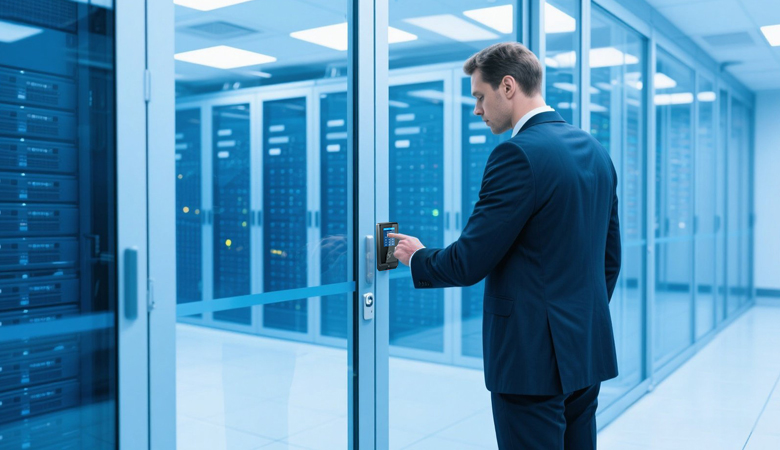
The initial layer governs entry to the server room or data floor itself. Implementing an advanced access control system for data center rooms requires a highly visible, robust terminal capable of running multi-factor authentication routines. This layer filters out general factory personnel, ensuring that only certified IT staff and verified system engineers can cross the threshold.
Within larger industrial facilities, server rooms are frequently shared between corporate IT, production automation teams, and third-party vendors (such as HVAC technicians or industrial software support teams). Deploying localized data center cage access control allows managers to partition the space. A vendor may have access to the main room to service cooling lines, but they remain physically locked out of the secure cages housing the core ERP and database storage units.
The final and most critical layer of defense focuses on the individual enclosure. Utilizing intelligent data center cabinet access control means that even if an individual gains access to the general room, they cannot physically access or modify a server blade unless they are explicitly authorized to manage that specific rack.
Implementing granular data center cabinet physical access control prevents accidental maintenance errors—such as a technician pulling a cable from the wrong production rack—and completely blocks unauthorized local USB drive injections, a common vector for industrial espionage and ransomware deployment.
To implement a zero-trust model across all three layers of an access control data center topology, facilities must deploy a combination of distinct data center access control methods. Relying on a single credential format creates a single point of failure; true modernization requires combining cryptographic hardware tokens, mobile applications, and biometrics.
For facilities that prefer RFID badges for day-to-day operations, the system must use high-frequency 13.56MHz smart cards rather than legacy proximity technology. CIVINTEC hardware natively supports MIFARE® DESFire® EV2/EV3 standards, wrapping all wireless communication in an unbreakable AES cryptographic envelope. The reader and card perform mutual authentication before any access data is transmitted, making card cloning virtually impossible.
Mobile access reduces the logistical burden of printing, issuing, and managing physical card inventories.
NFC Data Center Access Control: NFC provides a secure, intentional "tap-and-go" entry experience. Because NFC operates within a tight 4cm range, it ensures the user is deliberately requesting entry at that specific terminal.
BLE Data Center Access Control: BLE enables hands-free operation. This capability is useful for technicians carrying replacement server power supplies, networking switches, or tools into the data area, allowing them to unlock doors automatically as they approach.
Managing external contractors—such as third-party PLC programmers or facility technicians—is a frequent operational challenge for factory managers. An access control qr code reader provides an elegant solution for vendor tracking.
Through an integrated management console, administrators can generate a time-restricted QR code and send it directly to the contractor’s smartphone before they arrive on-site. The code can be restricted to work only during a specific maintenance window (e.g., Thursday from 2:00 PM to 5:00 PM) and can be limited to specific zones. Once scanned at the access control for data center terminal, the code is logged and automatically deactivated upon expiration, preventing unauthorized reuse.
Cards and mobile tokens represent tokens that a user carries. However, in high-security environments, true identity verification requires confirming who the user is. Integrating a biometric access control data center framework prevents credential sharing, buddy punching, and unauthorized badge use.
Facial Recognition Integration: Facial scanning offers a fast, contact-free verification option. Advanced biometric access controls data center security systems deploy dual-camera systems with infrared depth sensing. This design ensures accurate identification even in the fluctuating or low-light conditions common in older, retrofitted factory basements.
CIVINTEC designs and manufactures specialized access control terminals engineered to meet the strict security and environmental demands of modern data center access control management platforms. By processing complex cryptographic operations at the edge, CIVINTEC terminals provide real-time verification and continuous system reliability.
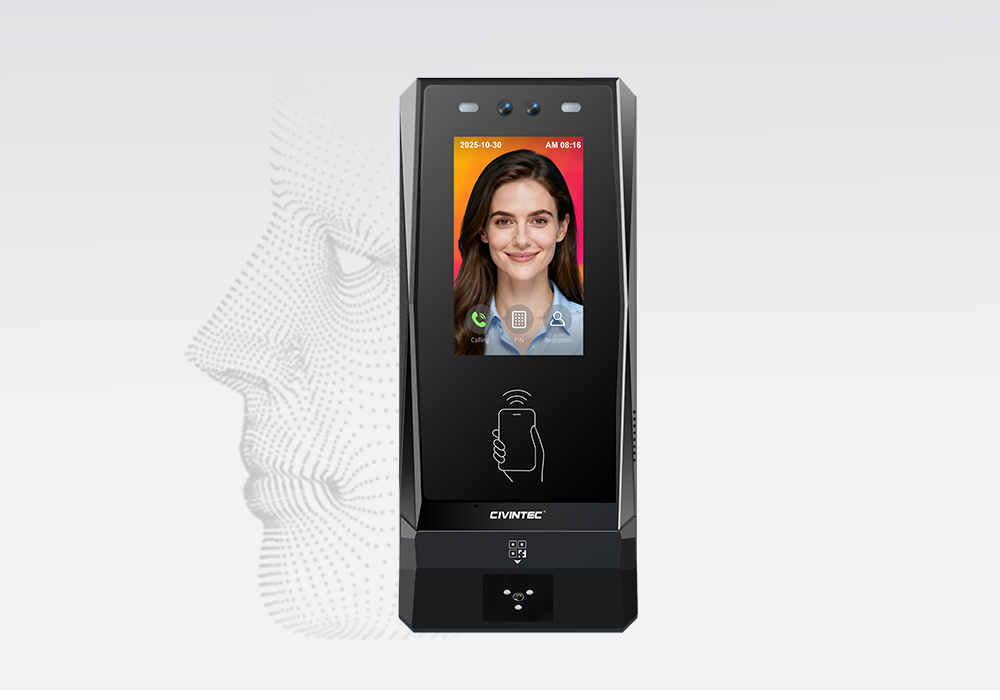
The CIVINTEC CT9 Pro access control terminal serves as an adaptable, high-security gatekeeper for critical infrastructure perimeters.
All-In-One Credential Processing: The CT9 Pro processes four credential formats simultaneously: 13.56MHz MIFARE DESFire smart cards, mobile credentials via NFC/BLE, dynamic QR codes, and secure PIN entry via a touch-screen keypad. This multi-technologies identification capability allows facilities to manage diverse user profiles—such as full-time IT staff, temporary vendors, and plant engineers—through a single access point.
Customizable Graphic User Interface (GUI): Featuring a clear 3.5-inch touch screen, the CT9 Pro allows organizations to load custom branding, warning messages, and multi-language instructions directly onto the terminal face.
Cloud Centralized Management : Support wire/wireless connectivity Ethernet(PoE), Wi-Fi, LoRaWAN, 4G LTE and enables cloud-based remote management, allowing door access control and real-time entry monitoring from anywhere to ensure efficient, centralized supervision across zones.
Robust Weather and Impact Resistance: Built with an IP65 ingress protection rating, the CT9 Pro is completely sealed against industrial dust, moisture, and chemical exposure, making it resilient in harsh manufacturing environments.
For environments requiring a sleek aesthetic alongside comprehensive Multi-Factor Authentication (MFA), the CIVINTEC CT10 access control terminal offers a powerful, modern option.
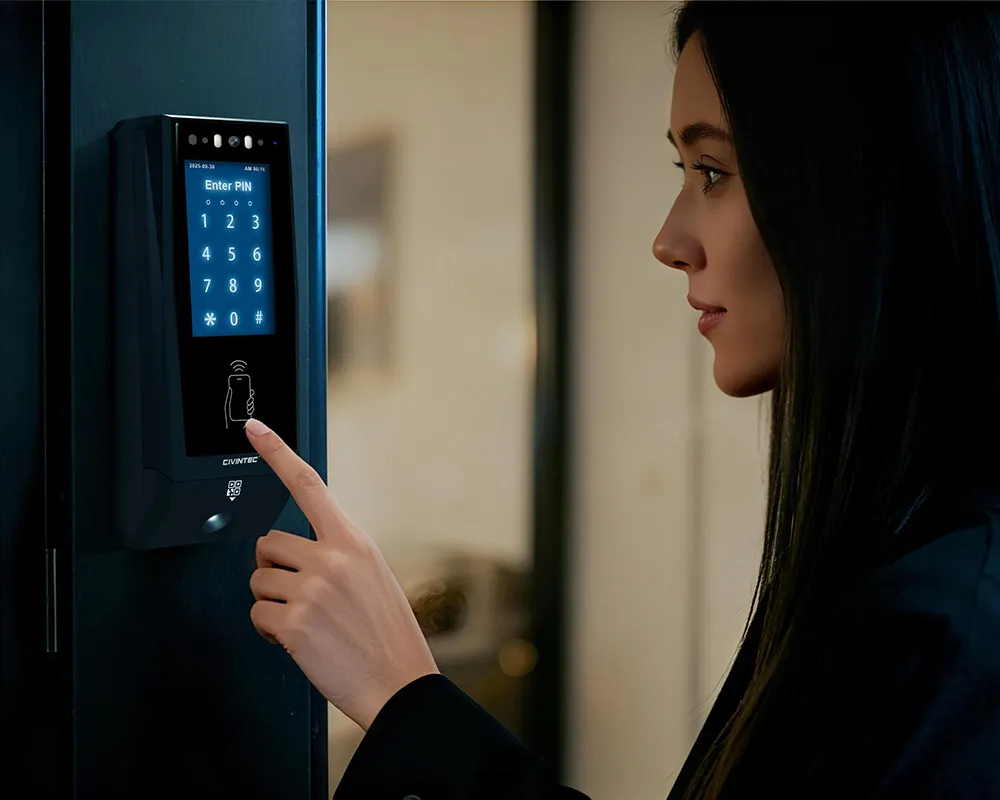
Enhanced Interactive Touch Interface: The CT10 features a highly responsive touch screen display, making it ideal for deployments that require users to navigate complex data entry screens or input multi-digit security codes.
Cloud Centralized Management : Support wire/wireless connectivity Ethernet(PoE), Wi-Fi, LoRaWAN, 4G LTE(GPS) and enables cloud-based remote management, allowing door access control and real-time entry monitoring from anywhere to ensure efficient, centralized supervision across zones.
Seamless Enterprise Integration: Equipped with dual-frequency reading cores and advanced communication interfaces, the CT10 connects directly with enterprise management platforms. This allows for real-time synchronization with active employee directories and automated security systems.
CIVINTEC hardware extends security down to the internal wire lines. Traditional access systems rely on legacy Wiegand interfaces, which transmit card data in unencrypted binary pulses. A bad actor with physical access to the wire lines can intercept this data using low-cost tools and play it back later to bypass the lock.
CIVINTEC hardware eliminates this risk by using the Open Supervised Device Protocol (OSDP v2):
Secure Channel AES-128 Encryption: All communication flowing between a CIVINTEC reader (like the Cidron or CT5, CK5 family reader) and the primary door controller is fully encrypted, preventing data sniffing and tampering.
Continuous Supervision: OSDP enables bi-directional communication, allowing the system controller to actively monitor the reader's health in real-time. If a line is cut or a reader is detached from the wall, a high-priority system alarm is triggered instantly.
Upgrading a legacy facility requires a structured approach that coordinates technology deployment with organizational workflows. Use this implementation checklist to ensure a secure, compliant installation:
Avoid running separate, siloed security systems for different areas of your plant. True protection requires a unified data center access control management platform that integrates your main room entry, inner security cages, and individual server racks into a single dashboard. This centralization simplifies employee onboarding, automates access privilege updates, and provides a single repository for compliance reporting.
For your outer perimeter, a single factor like a smart card or mobile token may be sufficient. However, for inner server rooms and restricted data center rack access control locks, you should always mandate at least two independent verification factors:
Access Granted = Something You Have (Smart Card/Phone) + Something You Know (PIN Code) OR Something You Are (Fingerprint)
By enforcing this multi-layered requirement, you ensure that stolen credentials or lost badges alone are not enough to grant access to your most critical infrastructure assets.
Regularly review access permissions to maintain a secure environment. Permissions should follow the principle of least privilege, granting individuals access only to the specific zones required for their current role.
Automated Expiration: Configure your system to automatically revoke access permissions for temporary contractors, interns, or seasonal employees after a set duration.
Real-Time Log Analysis: Integrate your access logs with a Security Information and Event Management (SIEM) system. This integration allows you to automatically flag unusual behavior patterns, such as an employee badge attempting to open a secure server rack outside of scheduled working hours.
[block2]
Modernizing a legacy server room is a critical investment in your organization's long-term operational resilience. In a global marketplace where digital downtime can stall production lines and compromise supply chains, physical security must evolve alongside digital defenses.
By moving away from unencrypted proximity systems and adopting a multi-layered, zero-trust framework built on CIVINTEC edge hardware, facilities can successfully close physical security loopholes. Combining the uncopyable security of MIFARE DESFire cards with the modern flexibility of mobile credentials, dynamic QR codes, and biometrics allows you to build an adaptable security network. CIVINTEC provides the hardware foundation—terminals that manage these diverse technologies simultaneously—to ensure your server environment remains safe, compliant, and prepared for the security demands of tomorrow.


 Home >
  Share
Share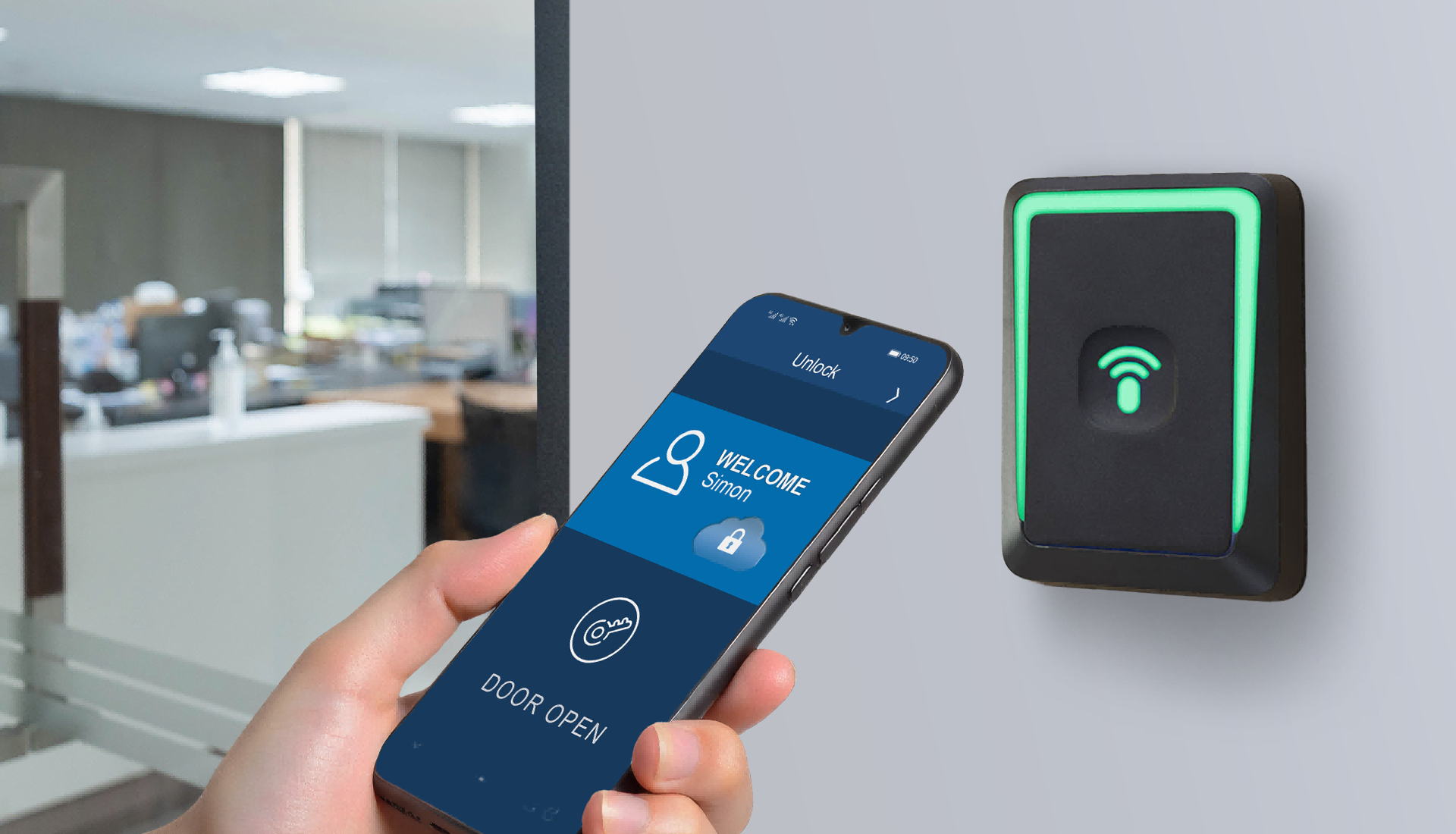



 Contact Us